BBC 中文网 | 时事专题 | Pundit Commentary | 中国农村地区生态环境状况令人担忧:
"中国农村地区生态环境继续恶化,主要表现在:
第一:城市的工业污染急剧向农村扩散;
第二:农业生产所使用的化肥、杀虫剂等对于土地和水体的污染依然持续;
第三:农村饮用水存在安全隐患,3亿多农村居民没有安全清洁的饮用水;
第四:自然生态继续恶化,沙漠化、次沙漠化、水土流失、湿地消失的趋势未能得到控制。
最近几年以来,有大量的污染企业或者是会产生大量的污染的产品从城市向农村转移。由于城居民的生态环保意识得到加强,迫使许多污染企业在不改造的前提下无法在城市继续生存下去。中国政府也在实际措施中鼓励污染企业从人口密集的城市向人口稀疏的农村转移。比如北京为了举办奥运会,将北京城中的污染企业迁到邻近的省区。因此各省区也纷纷仿效北京的做法,把污染企业从省会城市向农村转移。
在二十世纪的七、八十年代,工业发达国家也曾经把污染企业从城市转移到农村地区,期望能以此解决环境污染问题。但是不久他们就发现,这样做的后果不是减小了污染,而是扩大了污染,最终结果是不利于治理污染。因为农村地区人口较少,所能施加的政治压力也小。之后他们就放弃了这种做法(但是没有放弃把污染企业向发展中国家转移),而是坚持在当地进行改造,减少污染的排放。而中国目前则是继续工业发达国家曾经犯过的错误。在中国这种做法的危害更大。在西方社会中,农村人口的文化素质和环保意识和城里人没有区别,而在中国,农村人口的文化水平低,对环境污染危害的认识也比不上城里人。况且他们大部份人又不享受医疗保险,一旦遭到污染危及健康,后果十分严重。
业绩下的牺牲者
在中国,农村地区的党政官员为了创造业绩,牺牲当地农民的利益,积极引进污染企业,目的只有一个,提高县镇的GDP的发展速度,为自己的升官晋级提供敲门砖。他们最常用的说法就是,环境保护不能阻碍经济发展,环境保护不能妨碍发财致富。
最近暴露出来的云南省阳宗海水体污染事件,就是一个污染向农村转移的典型例子。造成这次水体污染的是云南澄江锦业工贸有限公司的一个化工厂,这是一个私有化了的镇办企业。他们生产的就是从城市向农村转移的有污染的化工产品。生产这种产品GDP高,所以是当地政府保护的'大企业'。该产品在生产过程中会产生大量含砷的废水。砷就是老百姓所说的砒霜。潘金莲害死武大郎用的就是砒霜。砷及其含砷化合物毒性很强,对人、蓄的健康有很大影响。砷化物主要损伤人体的神经系统、肝脏、皮肤等,可以致癌。
这些含砷的废水进入了湖泊,造成了水体的砷污染。据报导,该化工厂排出的废水中总共含砷67公斤!要是潘金莲有67公斤砷,能害死多少武大郎?世界卫生组织饮用水水质标准规定砷的浓度不能超过0.01mg/l,而在该公司阳宗海取水口以南25米处泉眼砷含量高达67.7毫克/升,竟为世界卫生组织饮用水水质标准的6770倍!
湖泊周围的居民,特别是渔民,常年就是直接饮用湖泊中的水。渔民以为只有水混才是被'搞脏'了,被污染了。他们根本不知道象砷这类有害物质的污染,并不会把水搞脏,但是其所含物质则是剧毒的。当地的环保部门设备简单,没有检测水中含砷物质的实验室设备,取到水样还需送到省城去化验,监测水质部份还是靠肉眼。
这样,在当地居民毫不知情的情况下,他们足足喝了三个多月含砷量超标的水,人体健康受到危害。
要改变中国农村地区生态环境恶劣的现状,中国政府必须采取确实有效的措施,当务之急,就是禁止再把污染企业或者是会产生大量的污染的产品从城市向农村转移。"
2.01.2009
1.04.2009
High-Rise
 [Image: Tower demolition in Philadelphia, as photographed by werdsnave. Perhaps that room at the very top could be rehabbed and kitted out with a small suburban house... or some version of this thing... making it worth the climb. Elsewhere: A tunneling project by werdsnave on Pruned. Earlier: Chicago's Inner Flute-Ruins].
from bldgblog
標籤:
architecture,
image,
Urbanism

Color Shift
 Ben Aranda and Chris Lasch, of terraswarm, creators of the infamous 10 Mile Spiral as well as the Brooklyn Pigeon Project, will be unveiling a new project on Monday night in Manhattan.
Called Color Shift, the installation "is an urban-scaled art project made by inputting a continuous stream of alternating colors into the FreshDirect video billboard, the largest in the country." As such, it's a kind of creative mis-direction of urban light pollution – a post-Duchampian optical relief in technicolor, throbbing through a dozen spectra across the roofs and walls of New York City.
 You can watch a virtual version of Color Shift, installed online – it's a weird, hypnotic abyss of slow alteration that, at one point, made my eyes feel broken. Very Olafur Eliasson-esque.
Ben and Chris will be speaking Monday night, March 19th, at 6:30pm in Columbia University's Wood Auditorium, Avery Hall. Tell them BLDGBLOG sent you.
from bldgblog
New Zealand is Droning
Apparently this sound (which I can only hear through headphones) is causing quite a stir in the northern districts of Auckland. The sound is so maddening, it seems, that it's inspired some residents "to take drastic action" – which, in one case, means purposefully deafening oneself with the roar of chainsaws.
In fact, "for those who can hear it, the sound is the bane of their lives."

The sound also reveals where unexplained acoustic phenomena, dishonesty, and urban real estate intersect: "Some have been reticent to give away more details of their predicament for fear that reports of persistent humming could adversely affect the resale price of their homes."
One of the researchers trying to locate the sound's origins "rules out geological factors. 'It's more likely to be things like pipes under the ground – you know, gas pipes, sewerage pipes, factories in the distance.'" CIA installations, perhaps.
"This is not the first incidence of humming in New Zealand," we're told. Oh, no. "In 2005, New Zealand author Rachel McAlpine wrote a book called The Humming... largely inspired by the author's own experiences in the seaside town of Puponga on the northwest tip of New Zealand's south island which was itself at the centre of a humming mystery some years back." That man was later arrested.
In McAlpine's novel we read how "life is becoming increasingly frustrating for [a character named] Ivan because he is plagued by an underground humming that he tries to disguise with an increasingly bizarre array of devices."
If it were my story to re-tell, however, Ivan would soon become so unbelievably good at manufacturing sonic camouflage that he turns into the terror of post-Blair Great Britain. (He moves to Britain). Completely silent, exploding noiseless weaponry over the city of Birmingham, Ivan's Joseph Conrad-inspired, acoustically avant-garde ransom demands are met not with payment stashed inside a pre-arranged safety deposit box – but by a visit from a certain, rather well-known, secret agent of the crown... Unfortunately, James Bond is almost immediately captured – having been dumbfounded by a house full of mirrored rooms, someone else's mobile phone, and a weird echo, coming as if from behind him, that induces a state of cognitive paralysis. Bond is then subjected to a series of unbearable noise-tortures, leading some in the audience to laugh and others to accuse the film of being an unacknowledged remake of The Ipcress File. But, once the enemy is brought back on screen, transformed by his life of sonic dissimulation, he addresses Bond through a grotesque series of hand-held voice-cancellation machines – and we see that something altogether more terrifying has been planned...
Of course, it has long been known that if you "listen carefully... you can hear the Earth singing quietly to itself."
from bldgblog
(Thanks, Marcus! Earlier: Sound Dunes, Dolby Earth, and so on).
In fact, "for those who can hear it, the sound is the bane of their lives."
The sound also reveals where unexplained acoustic phenomena, dishonesty, and urban real estate intersect: "Some have been reticent to give away more details of their predicament for fear that reports of persistent humming could adversely affect the resale price of their homes."
One of the researchers trying to locate the sound's origins "rules out geological factors. 'It's more likely to be things like pipes under the ground – you know, gas pipes, sewerage pipes, factories in the distance.'" CIA installations, perhaps.
"This is not the first incidence of humming in New Zealand," we're told. Oh, no. "In 2005, New Zealand author Rachel McAlpine wrote a book called The Humming... largely inspired by the author's own experiences in the seaside town of Puponga on the northwest tip of New Zealand's south island which was itself at the centre of a humming mystery some years back." That man was later arrested.
In McAlpine's novel we read how "life is becoming increasingly frustrating for [a character named] Ivan because he is plagued by an underground humming that he tries to disguise with an increasingly bizarre array of devices."
If it were my story to re-tell, however, Ivan would soon become so unbelievably good at manufacturing sonic camouflage that he turns into the terror of post-Blair Great Britain. (He moves to Britain). Completely silent, exploding noiseless weaponry over the city of Birmingham, Ivan's Joseph Conrad-inspired, acoustically avant-garde ransom demands are met not with payment stashed inside a pre-arranged safety deposit box – but by a visit from a certain, rather well-known, secret agent of the crown... Unfortunately, James Bond is almost immediately captured – having been dumbfounded by a house full of mirrored rooms, someone else's mobile phone, and a weird echo, coming as if from behind him, that induces a state of cognitive paralysis. Bond is then subjected to a series of unbearable noise-tortures, leading some in the audience to laugh and others to accuse the film of being an unacknowledged remake of The Ipcress File. But, once the enemy is brought back on screen, transformed by his life of sonic dissimulation, he addresses Bond through a grotesque series of hand-held voice-cancellation machines – and we see that something altogether more terrifying has been planned...
Of course, it has long been known that if you "listen carefully... you can hear the Earth singing quietly to itself."
from bldgblog
- They live underground. They are everywhere but seem to come from nowhere. They barely exist, but never leave. If sounds have shadows, they are the shadows of a sound. Researchers call them the background free oscillations of the Earth.
(Thanks, Marcus! Earlier: Sound Dunes, Dolby Earth, and so on).
1.03.2009
Lime Works / Mineral Futures / Surface Excavations

Though the work of Naoya Hatakeyama has just been explored elsewhere, these photographs – entitled Lime Works (Factory Series) (1991-94) – totally blow me away.

For starters, their extraordinary density almost imitates the stratigraphy of the rocks being scraped through –

– even while they document how an increasingly powerful part of the human population interacts with the earth's surface: through highly technical, and very large, digging machines. Entire architectural complexes, instant cities, lit from within and steaming.
They document, in other words, the human interaction with geology.
Here, of course, that interaction takes the form of an excavation complex crossed by elevated walkways – and it looks like something straight out of Star Wars –

– or a kind of mineralized King Arthur, ruling from behind a Camelot of mines...

But these photos also bring up the global market in rocks – or the financialization of geology through mineral futures, where taxed and quantifiable fragments of the earth's surface can be traded as commodities on the futures market.
Lime, after all, is a very useful mineral, with entire international associations and Mineral Information Institute reports devoted to its scientific study, value, and market exploitation.
As that latter link informs us, in fact, "Lime has been used for thousands of years for construction. Archeological discoveries in Turkey indicate lime was used as a mortar as far back as 7,000 years ago. Ancient Egyptian civilization used lime to make plaster and mortar."
Meaning, of course, that these photographs show us an architecture of machinery busy digging up a mineral – that will be used by more machinery in the construction of future architecture. (That, in many ways, is the closed loop of the extraction industries: a campsite digging for oil – because its drills need more oil... At some point the whole thing becomes not unlike performance art.)
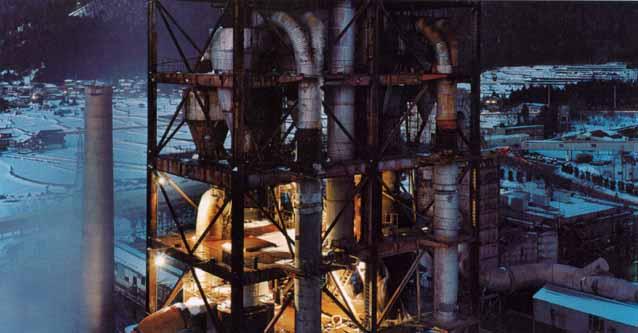
[Image: A lime works excavation tower seen against the landscape it will soon absorb. If the earth could make horror movies, one wonders if this would be the opening scene...]
I'm left with speculation:
If human beings actually do survive the next ten thousand years; if all this excavation not only continues but accelerates; if usable mineral deposits continue to be found, but only deeper and deeper beneath the earth's surface; then perhaps we might find that we've stripmined every continent below the waterline, returning the earth to the early Devonian, when warm, shallow seas covered most of the planet – only now, or then, the earth will be shelled by a new global city of interlocking excavation architectures – gantry cities, derrick towns, Constant's Babylon –
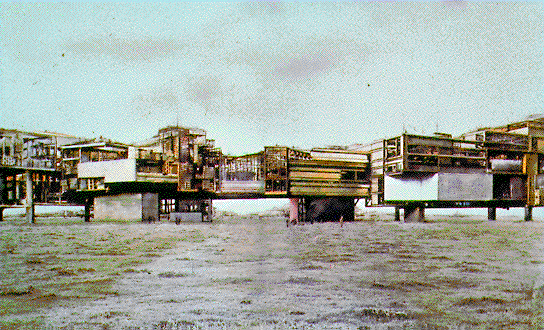
– complete with feudal rock-salt guilds and a new U.N. of floating lime works factories.
But deep below, in the dark webbing of undersea buttresses, where barrel vaults are covered with scabs of bleached coral, future geologists will be found scuba diving, like Steve Zissou, seeking out new metals and mineral deposits, torch in hand, scouring the outer edge of a flooded earth, diving further and further toward the core.
Then, one day, the digging machines simply put themselves out of business – because the planet has disappeared.
from bldgblog
標籤:
crazy human,
crazy times,
image,
Urbanism
12.31.2008
Nuclear Urbanism
A Google Maps mash-up by Sydney-based design firm CarlosLabs has us looking at what nuclear explosions would do to cities all over the world.
 [Image: London nuked, courtesy of CarlosLabs].
"This mapplet," we read, "shows the thermal damage caused by a nuclear explosion. Search for a place, pick a suitable weapon and press 'Nuke It!'"
The image you see above is London as decimated by an atomic bomb equivalent to the freakishly terrifying Soviet Tsar Bomba test of 1961. Everything as far as Guildford has been damaged – the entire center of the city simply gone.
Below, we see Chicago obliterated by the same size of explosion. Looking closely, we see that the difference between a first- and second-degree burn – and this information is explained a bit more, below – passes directly through the distant suburban town in which I was born, Highland Park.
 [Image: Courtesy of CarlosLabs].
Waters along the shore of Lake Michigan would be instantly evaporated, forming radioactive rainstorms over northern Indiana, perhaps for days.
The size of the bomb can be varied, of course; here we see Los Angeles hit by any typical nuclear warhead carried by an American fighter jet, circa 1991; and, below that, we see New York City hit by a bomb equivalent to Fat Man, the device dropped on Nagasaki.

 [Images: Courtesy of CarlosLabs].
And here, below, is Rome hit by Little Boy, the bomb dropped on Hiroshima – and the first nuclear device ever used as an act of war.
If it's any consolation to Catholics – or architectural historians – the extreme, northwestern fringes of the Vatican would escape immediate harm.
 [Image: Courtesy of CarlosLabs].
Alternatively, let's drop Little Boy on Edinburgh.
 [Image: Courtesy of CarlosLabs].
All of this is visually arresting – seeing vast bruises like bull's eyes consume whole cities – but what does it really mean? What is each colored circle supposed to represent?
In the following image of Mumbai being hit by a nuclear missile equivalent to those used by the Chinese military, we see concentric rings of 1st, 2nd, and 3rd degree burns expanding outward from the detonation – a geometry of necrosis, suffocation, and death. Blisters and cancer would affect tens of thousands of people for miles in every direction (depending on prevailing winds).
 [Image: Courtesy of CarlosLabs].
For some unexpected astronomical context, though, CarlosLabs has added a bizarre final option: seeing how asteroid impacts might compare with inter-urban nuclear war.
Tokyo – where the following image is centered – is not merely erased; struck by an asteroid, it's been placed at the heart of a planetary event, complete with rings of sunburn-equivalent injury spreading out across whole continents.
 [Image: Courtesy of CarlosLabs].
Returning to the realm of historical likelihood, the image that somehow clarifies this the most for me – if, for no other reason, because I live there – is the following glimpse of San Francisco. The entire peninsula has been blasted into absolute, smoking oblivion by an explosion equal to Tsar Bomba.
The fact that you would be more or less screwed as far south as Fremont – and well east of Oakland – seems sobering, indeed.
You could be sitting in the west-facing window of an Oakland high-rise, watching an atomic fireball explode over San Francisco – which quickly expands to melt the glass you're looking through.
 [Image: Courtesy of CarlosLabs].
A few quick points, meanwhile:
1) This will mean very little, and have no effect, but I am 100% behind complete nuclear disarmament. The U.S. taking the lead in this seems like something well worth pursuing.
2) In this context, I have to say that the books of Richard Rhodes cannot be recommended highly enough. His The Making of the Atomic Bomb – which I have to confess to having read only partially – is required reading for anyone interested in what intensive, well-funded efforts of design can – in this case, unfortunately – produce. The bomb as an act of national infrastructure.
3) Michael Light's book 100 Suns, a photographic survey of nuclear weapon tests, is as horrifying as it is visually spectacular, especially for anyone with an interest in human history (and its explosive intersection with enriched geology).
4) Gary Snyder has a great poem that I still think of now and again, 17 years after first reading it, called "Bomb Test." Originally written, I believe, in Kyoto in 1986, the poem presents nuclear weapons as a kind of new terrestrial element, something geologically unprecedented both in and on the surface of the earth – highly processed samples of mineral chemistry (uranium, plutonium) put into military service by rival superpowers.
"The fish float belly-up, for real," Snyder writes. "Uranium in the whites / of their eyes.
Even now, the globally nomadic residues of nuclear weapons tests form a ghostly stratigraphic marker that can be found literally around the world, an all but permanent part of the earth's sedimentary record.
So, in the images that illustrate this post, we see what effects this geological discovery – the explosive power of rare elements – could have on the built geography of our species.
Nuclear war thus poetically equates to hurling enriched fragments of the earth's surface at your rivals. Call it weaponized geology: minerals made altogether unearthly, if not post-terrestrial, through anthropological intervention.
5) Here is a random assortment of nuclear bomb photography. These were all Cold War-era tests – but, someday, perhaps soon, architects and architecture bloggers will be looking at similar images, images that have captured the obliteration of constructed environments from Mumbai or Karachi to New York, London, or Tehran. This will happen, I would say; it might well occur within our lifetimes, or at least within the next century; and any even partially accurate future assessment of global urbanism must still take nuclear weapons into account.
Nuclear weapons present us with a kind of demonic skeleton key, capable of catastrophically unlocking any city in the world, no matter how dense or well-fortified, in mere seconds.
 Finally, here is what would happen if a nuclear bomb was dropped on a relatively non-urban environment: in this case, the town of Chapel Hill, North Carolina.
 [Image: Courtesy of CarlosLabs].
But this could just as easily have been Ann Arbor, Santa Cruz, Austin, Shrewsbury, Castleton, Aberystwyth, Marburg – it could just as easily have been anywhere on earth.
The overwhelming obliterative power of nuclear weapons turns them into a kind of ubiquitous anti-landscape, something that no geography, built or natural, can successfully resist.
All of which is simply a long-winded way of saying that while we now tend to measure threats against our cities in terms of armed gangs or contextually minor moments of staged terrorist assault, it's still interesting to remember that, hovering over all of this, is something that could simply annihilate cities altogether.
If we're going to study cities, in other words, then we should also study that which is radically anti-city.
(Spotted via Alexis Madrigal and Wired Science). From http://bldgblog.blogspot.com/
[Image: London nuked, courtesy of CarlosLabs]."This mapplet," we read, "shows the thermal damage caused by a nuclear explosion. Search for a place, pick a suitable weapon and press 'Nuke It!'"
The image you see above is London as decimated by an atomic bomb equivalent to the freakishly terrifying Soviet Tsar Bomba test of 1961. Everything as far as Guildford has been damaged – the entire center of the city simply gone.
Below, we see Chicago obliterated by the same size of explosion. Looking closely, we see that the difference between a first- and second-degree burn – and this information is explained a bit more, below – passes directly through the distant suburban town in which I was born, Highland Park.
[Image: Courtesy of CarlosLabs].Waters along the shore of Lake Michigan would be instantly evaporated, forming radioactive rainstorms over northern Indiana, perhaps for days.
The size of the bomb can be varied, of course; here we see Los Angeles hit by any typical nuclear warhead carried by an American fighter jet, circa 1991; and, below that, we see New York City hit by a bomb equivalent to Fat Man, the device dropped on Nagasaki.
[Images: Courtesy of CarlosLabs].And here, below, is Rome hit by Little Boy, the bomb dropped on Hiroshima – and the first nuclear device ever used as an act of war.
If it's any consolation to Catholics – or architectural historians – the extreme, northwestern fringes of the Vatican would escape immediate harm.
[Image: Courtesy of CarlosLabs].Alternatively, let's drop Little Boy on Edinburgh.
[Image: Courtesy of CarlosLabs].All of this is visually arresting – seeing vast bruises like bull's eyes consume whole cities – but what does it really mean? What is each colored circle supposed to represent?
In the following image of Mumbai being hit by a nuclear missile equivalent to those used by the Chinese military, we see concentric rings of 1st, 2nd, and 3rd degree burns expanding outward from the detonation – a geometry of necrosis, suffocation, and death. Blisters and cancer would affect tens of thousands of people for miles in every direction (depending on prevailing winds).
[Image: Courtesy of CarlosLabs].For some unexpected astronomical context, though, CarlosLabs has added a bizarre final option: seeing how asteroid impacts might compare with inter-urban nuclear war.
Tokyo – where the following image is centered – is not merely erased; struck by an asteroid, it's been placed at the heart of a planetary event, complete with rings of sunburn-equivalent injury spreading out across whole continents.
[Image: Courtesy of CarlosLabs].Returning to the realm of historical likelihood, the image that somehow clarifies this the most for me – if, for no other reason, because I live there – is the following glimpse of San Francisco. The entire peninsula has been blasted into absolute, smoking oblivion by an explosion equal to Tsar Bomba.
The fact that you would be more or less screwed as far south as Fremont – and well east of Oakland – seems sobering, indeed.
You could be sitting in the west-facing window of an Oakland high-rise, watching an atomic fireball explode over San Francisco – which quickly expands to melt the glass you're looking through.
[Image: Courtesy of CarlosLabs].A few quick points, meanwhile:
1) This will mean very little, and have no effect, but I am 100% behind complete nuclear disarmament. The U.S. taking the lead in this seems like something well worth pursuing.
2) In this context, I have to say that the books of Richard Rhodes cannot be recommended highly enough. His The Making of the Atomic Bomb – which I have to confess to having read only partially – is required reading for anyone interested in what intensive, well-funded efforts of design can – in this case, unfortunately – produce. The bomb as an act of national infrastructure.
3) Michael Light's book 100 Suns, a photographic survey of nuclear weapon tests, is as horrifying as it is visually spectacular, especially for anyone with an interest in human history (and its explosive intersection with enriched geology).
4) Gary Snyder has a great poem that I still think of now and again, 17 years after first reading it, called "Bomb Test." Originally written, I believe, in Kyoto in 1986, the poem presents nuclear weapons as a kind of new terrestrial element, something geologically unprecedented both in and on the surface of the earth – highly processed samples of mineral chemistry (uranium, plutonium) put into military service by rival superpowers.
"The fish float belly-up, for real," Snyder writes. "Uranium in the whites / of their eyes.
- They've been swimming
Deep down where it's black when a
Silvery snow of something queer
glinted in
From cirrus clouds to the seamounts,
Through all the food chains,
Shrimp to tuna, the currents,
Riding the waves.
Even now, the globally nomadic residues of nuclear weapons tests form a ghostly stratigraphic marker that can be found literally around the world, an all but permanent part of the earth's sedimentary record.
So, in the images that illustrate this post, we see what effects this geological discovery – the explosive power of rare elements – could have on the built geography of our species.
Nuclear war thus poetically equates to hurling enriched fragments of the earth's surface at your rivals. Call it weaponized geology: minerals made altogether unearthly, if not post-terrestrial, through anthropological intervention.
5) Here is a random assortment of nuclear bomb photography. These were all Cold War-era tests – but, someday, perhaps soon, architects and architecture bloggers will be looking at similar images, images that have captured the obliteration of constructed environments from Mumbai or Karachi to New York, London, or Tehran. This will happen, I would say; it might well occur within our lifetimes, or at least within the next century; and any even partially accurate future assessment of global urbanism must still take nuclear weapons into account.
Nuclear weapons present us with a kind of demonic skeleton key, capable of catastrophically unlocking any city in the world, no matter how dense or well-fortified, in mere seconds.
Finally, here is what would happen if a nuclear bomb was dropped on a relatively non-urban environment: in this case, the town of Chapel Hill, North Carolina.[Image: Courtesy of CarlosLabs].But this could just as easily have been Ann Arbor, Santa Cruz, Austin, Shrewsbury, Castleton, Aberystwyth, Marburg – it could just as easily have been anywhere on earth.
The overwhelming obliterative power of nuclear weapons turns them into a kind of ubiquitous anti-landscape, something that no geography, built or natural, can successfully resist.
All of which is simply a long-winded way of saying that while we now tend to measure threats against our cities in terms of armed gangs or contextually minor moments of staged terrorist assault, it's still interesting to remember that, hovering over all of this, is something that could simply annihilate cities altogether.
If we're going to study cities, in other words, then we should also study that which is radically anti-city.
(Spotted via Alexis Madrigal and Wired Science). From http://bldgblog.blogspot.com/
標籤:
google maps,
image,
Urbanism
订阅:
博文 (Atom)