2.27.2009
Midi into Processing
1-st sketch Just getting processing to detect midi notes
see more http://vimeo.com/3312636 by m8roberto

2.25.2009
Douglas Edric Stanley
This is a interactive instrument allowing you to make music with your Rubik's Cube.
It will be exhibited at the ZeroOne exhibit in San Jose from August 7-13, 2006. The on-line emulator has been available for a while ( cf. http://www.abstractmachine.net ), but this is the first working version of the physical terminal you can manipulate by hand.
I was so excited that I quickly set up a camera, forgot to do a decent white balance, and did a one-take video recording with the crappy Quicktime Midi Instruments. So don't expect much. Obviously I'll have better instruments for the exhibit, but you'll have to wait for that. I need to move on to the next terminal as this one took a long time to finalize. But if you're curious as to how the system works, you can check out the vidceo. Just keep in mind that this is an early demo...
via http://www.youtube.com/watch?v=UjmZo9hmeII
Interview (访谈)with Douglas Edric Stanley

在硅谷出生长大的Douglas Edric Stanley,十年来却一直在巴黎、埃克斯普罗旺斯以艺术家、理论家及研究者的身份工作。目前他作为数字艺术专业教授供职于埃克斯普罗旺斯艺术学校(Aix-en-Provence School of Art),教授编程、交互学、网络及机器人学。他为众多研讨会讲授基于编码的艺术及其研究成果,在世界各地的数字艺术展览及艺术节上展示自己的作品,还是埃克斯普罗旺斯LOEIL实验室的一名研究员。同时他在巴黎第八大学(University of Paris 8)研究“艺术创新的演化与世界算法化的联系”,并且成为其交互美学实验室(Laboratory for Interactive Aesthetics)的博士后选人。几个月前,Douglas Edric Stanley邀请我去埃克斯普罗旺斯高等艺术学校(Ecole Supérieure d’Art d’Aix-en-provence) 发表讲话。在互通几封e-mail并看到他在学校所做的工作之后,我觉得他会是个完美的采访对象:不仅是他有趣的工作,而是他以其简洁的语言解释了那些听 着异常复杂的新发明和动态(尤其是满足了像我这样不那么聪颖的人不用费什么脑筋就明白一切)。最重要的是,他完全不忌讳谈论自己的真实想法。
这次访谈比以往要长,但我不想做任何删减或编辑。它值得一读,充满了令人惊艳的见解并对法国新媒体艺术的(悲哀)现状、使用Rubik魔方创作音乐、实用计算机处理技术路向何方、“新媒体艺术家”以及在声誉极高的艺术节上展示自己作品的真正意义等问题作了相当大胆的阐述。
能跟我们说说你为圣何塞ZeroOne做的关于抽象机器的研究项目么?
先做个概念性的解释吧。抽象机器本质上并不是一件艺术品,而只是一个研究项目,或者说是一个平台。这十年来我一直在探索的一个理论假说,最近才将其 转变成围绕着由模块统治的那些新兴知识的某种宣言。在这里,物体一直被不停改变的规则和条款所限制,而那些编程机器创造出来的不仅仅是一种新的美学,也重 新提出了问题“什么是美学?”
我们经常谈论“交互”,在这方面我可能还是个专家,至少曾经可能是(比较:http://www.abstractmachine.net /lexique)。但随着时间的流逝,我逐渐意识到“交互”只是冰山一角,当我枉费心机地探索时,源源不断创作各种玩意儿的想法在黑暗中闪现了灵光。同 时,我非常厌恶当代艺术界那种自命不凡带给这些小玩意儿的诋毁,在面对这些通常看起来简单甚至孩子气的装置时,他们却目不识珠,看不到其中崭露头角的新兴 领域。所以我现在正试着改进这些小东西,同时保留那些使它们超越“玩意儿”身份的引人之处。
在我改进这些东西的时候,我看到周围同时期的艺术家们也为不同的交互装置做着同样的努力,各种为艺术家创作的软件、乐器及平台频出。我同一些学生甚至创作 出了一种道德指南针,它的发展经过了以下阶段:应激性-〉自动化 -〉交互 -〉 工具 -〉平台。因此抽象机器就是试图在推动并实践我们的理念:从这种简单的应激交互发展成为工具或平台的形式。比如顺着这样一种思路,我们正在搞一种比所谓的 “工具(tools)”规模大得多(不幸的名词),而实际上不仅仅是小玩意儿的东西。

有了以上的引言,我来具体描述一下这对ZeroOne艺术节的意义何在。我计划了四个“终端(terminals)”,一端是为音乐创作,一端给游戏开发,另外两端是为算法电影准备的。这些终端与在线的“模拟器”相连,允许用户在线或在上下文中使用抽象机器。如果一切顺利,圣何塞的人们就能与物理终端相连,而其他在线用户则可以使用模拟器。当然这两种体验不尽相同,但各有千秋。
虽然这些作品都阐述了从编程和物理上接入算法的想法,我对细胞自动机(cellular automata)的大型多触手接口(tentacular interfaces)、模块式机器人构件或联接着某个怪异的生物统计学泳装的大型神经网络并没有太多兴趣。“算法”与复杂的拜物教不同。所有抽象机器上 的终端都很简单,采用简单的接口:音乐创作使用Rubik魔方,游戏开发使用gameboy(既任天堂掌上机),由乐高摄像头制作电影并通过可触屏观看。所有的设备都允许人们算法化地摆弄这些媒体、对象/图片/声音。逻辑通常像拼图、玩具、镶嵌一样,简单但同时有效的计算机编程形式。这些都是真正的算法,只不过是通过简单对象和姿势完成操作的。
共生图

向交互的转移在历史上是意义深远且明智的一笔,但伴随而来的是——藏在这些交互身后的算法——这才是真正的转移。但什么是算法呢?你能掌握它么?它 是不是类似什么东西呢?又有谁能搞定它呢?答案当然是肯定的。这些年来,我逐渐意识到这些额外的补充其实很简单,任何人都能明白。事实上,所有这些困难并 不存在——至少是以我的视角——处于游戏编程与玩游戏之间。开发者将我们剔除出编者团队,但我们与这些游戏中读到的源代码依然有着联系。当你玩游戏的时 候,也就是在反编程,探索如何反向构建它。我们接触代码,熟悉它,然后应用它。那么为什么不将这一过程更直观地面向用户呢?这个过程的起步要易于接受,更 重要的是还要使它显得“美味可口”。
在我所做的努力中最显著的例子也是最有趣的,它被称为^3,或简单点叫cubed。想法很简单:用Rubik魔方谱写编排一段乐曲。魔方每一面都代表不同的乐器,而不同的颜色代表乐器发出的不同音符。每个乐器/面的速度,以及它们的声音大小取决于你如何放置魔方。每一面都演奏一个循环,就跟其他基本的电子乐音序器一样,通过操纵魔方你就能操纵音序器。
电子乐音序器的魅力就在于,循环都很短以至于作曲(安放音符)这一动作与演奏这些音符相叠。如果你确实很厉害,你可以在两个循环间换音,将作曲的音序器变 成一个音一个音的乐器而结束。所以一方面^3毋庸置疑是一个音序器——用来创作模块化音乐结构——它同时也可以更加华丽点,用做全功能的现场演出乐器。
在线使用这个程序是免费的,其接口与所有midi设备/软件都兼容。如果来圣何塞的展览上看看,你可以亲身体验用魔方创作音乐,甚至带着自己的魔方来(Bring Your Own Rubik’s Cube)——因此还产生出了新名词:BYORC音乐。我期待来自speedcubing的疯狂DJ用这创作出疯狂的breakcore片断并随着音乐一起疯狂。而在视觉层面上,当你站在人群前抱着一个Rubik魔方变换着你的作曲算法,那就是一场秀。

创意来自某次我观看Autechre的音乐会。那次的音响系统很糟糕,而唯一被滤出的循环采样来自庞大循环节奏结构。我观察他们构建结构,唯一能辨认的是闪烁的点点灯光划过节奏音序器的调节钮。我想可能在什么地方采用了Max/MSP——他们是因此出名的——但这个线性音序器看起来在音乐的构建上有着重要的地位。这些音序器很有意思,但这就是我们希望电子音乐发展的方向么?50年来人们都不太正常,而303 Groovebox是 我们能想到的最理想的电子乐器了。所以我开始思考有没有什么东西很有趣,漂亮,设计简单,但让音乐人掌握起来超级困难。只要改变一面就能搞砸其他面的完美 节奏。每个节奏旋律结构都是相互联系成网的,所以想掌握只有学习简单但难记的Rubik魔方算法。这可能也是对电子音乐天才们的一个严峻考验吧。让这些人 也玩玩这超他妈难的乐器!
不要错过录像!
为什么对Rubik魔方这么有兴趣呢?是儿时的美好回忆么?
应该说不是。我可讨厌那东西了,也玩不转它。我的兄弟们还有我的一些极客朋友知道如何玩魔方。像我这样在硅谷长大的孩子,身处家庭电脑/BBS/游 戏机大潮之中,周围确实有很多未来天才知道如何玩魔方。不过我自己没有这样的天赋。在编程上,我的天赋也差不多一样糟糕。我在来巴黎国际哲学研究院学习 前,我才开始意识到这些机器存在以及最终掌握它们的重要性。所以我不得不搬去巴黎——学习哲学——明白自己从哪里来,明白为什么像Simon和Rubik魔方以及Pacman这样的东西都是与我一同成长起来的新兴算法文化的一部分。
但即使是那些成长在中部某地的人们都知道Rubik魔方,这不仅仅是单纯的天才现象。因此它带有种80年代的怀旧气息,但更多的还是关于寻找最大众的算法演奏界面,并将其发展成一种工具。
你的工作涉及编程、交互、网络和机器人学。看上去这些都是大相径庭的学科。你同意么?你又是如何赶上这些学科飞速的发展步伐呢?
事实上有许多工作都是紧随其后的-——每个学科都迅速发展(可能交互是个例外)——而我确实厌倦与所有领域的发展步伐保持同步。我花了十年的时间去了解进展如何。那十年多多少少算是一个结束,现在是该继续前进的时候了。

Light on the Net 和 Telegarden

也就是说,这些科目实际上都是有着紧密的内在联系。想象一下你专攻交互图形而对身边网络的发展毫不关心,这是很荒谬的。同时,这些交互视觉项目也开 始着眼于日常生活用品(= 为何设计如此重要),而这些日常用品像以前我们只能通过计算机屏幕了解的图形用户界面一样越来越模块化。所以机器人学,或至少是电子学,并非是分立的领 域,而是目前形势的必然结果,实际上也是网络图形界的一个界面。网络+图像+机器人+电子间的界限越来越模糊。从藤幡正树(Masaki Fujihata)的Light on the Net开始,还有Ken Golderg的Telegarden, 不断前行。这些将逐渐引领至算法化植物结构和可生长的动态媒体建筑甚至一些我们还不甚了解的东西。另外批判艺术组合(Critical Art Ensemble)、Preemptive Media、Eduardo Kac、Joe Davis等对模块化生物学知识进行的大胆探索,你可以发现很多类似的聚合——oops,蜕变(Transvergence)——正在进行。
你也可以为以上的单子加进一个新的分类:除了编程、网络和机器人学,我新近添了三维模型到我的“宝库”,并开始了一个开发商业游戏的新项目。这也是我热衷将Processing(一个用来编制图像、动画及声音的开源编程语言和环境)引入我在埃克斯普罗旺斯的工作室的 原因之一。我一直希望能和学生们采用—编程,但这对他们来说起步相当困难。在Processing中,工作在DDD下与工作在DD下是非常相似的。事实 上,最终能有这样一个可以明确地呈现多元化思维/工作的环境,对我来说也是很有趣的。有了Processing这样一个环境,我们可以在文字与图像、马 达、模型、快速原型法机器、传感器等等之间转换。如我对Macromedia Director的爱之深,我对Flash的恨也之切,因为你没办法将其插入任何东西之中。我得承认Director这点确实做的不够,而这正是我在埃克 斯普罗旺斯主攻的内容。你不可能打败一群工作在开源环境内的极富目的性的艺术家。所以,软件硬件平台都要往这种混血儿的方向发展,就如同我的简历一样。这 些交互性的小玩意儿确实需要“实践”。
再回到单子来,目前我的兴趣是:编程、交互、网络、机器人、仿真和游戏。与机器人学一样,我们现在很清楚在游戏界发生了一些事情——即使它们仍饱受 着任何交互艺术都在饱受的困扰。但与交互艺术不同,游戏是从地下开始展露头角的,这也正是我想探索的。索尼和微软都将这抛诸脑后,任天堂看起来倒是意识到 了一些。我还未着手Wii controller(一种新型游戏手柄),不过若真如冀希的那样,我们肯定会在交互学上向前迈进一大步。今后我们还会进一步融合所有这些领域。
可以简单描述一下你在艺术创新的演化与世界算法化的联系这方面的研究么?
首先,我对与计算机数字性或计算性不同的算法特性很感兴趣。当我们谈论算法的时候,就是谈论计算机处理——它是如何命令任务和活动,在引入新数据后 如何自我调节。“算法”这个词虽然听起来很复杂,其实只是一个非常简单的概念。它正是计算机中让你“做事”并且自己知道该如何去做的部分。你给它一些指令 (程序),它就会根据这些指示工作。如果你将什么东西格式化为电脑可以理解的,它就会自己去处理。使用一些东西处理另外一些东西,这就是算法。你可以叫它 编程,也可以叫它算法。它让你从本质繁杂的代码中跳出来,从一种更理论化的层面来看待这些机器动态、模块化的性质。以这个视角来看,世界上的一切都可以慢 慢被格式化成算法进程——所以所有的一切都可以有自动化机器来操作。
这与先前的回应事实上是有联系的。我相信人们现在已经注意到机器人学正在慢慢物化那些我们以前只有在屏幕上才了解的算法。这就是我为什么有时候会提 到算法的“物理化”,它不同于“物质化”,那指一种更物质性更天然的变化或过程。对于现实的世界,机器人学是一种应用型程序界面,是允许现实世界访问数 组、循环、指针、逻辑算子及子程序的方式。几年前我就在法国寻求资金支持研究“GUI第二的机器人学”。我称这个项目为“面向对象的对象”。屏幕通常只是 作为操作窗口用来显示那些需要形象化的东西,当你看到那些进行快速原型法的一切时,这种直觉似乎(差不多)变得充实了。电脑的无穷模块化并没有停步在屏 幕、在文件夹或者复制-粘贴媒体。这种模块化威力巨大,远远超出屏幕这个范围。显然,Media Lab crowd已 经做了很多,他们才是这一领域的先锋人物。也就是说,这种变化所带来的理论冲击我们研究的还是太少。我还能看到传感和制动:也就是捕捉数据、发出噪音以及 运行其他东西的部分。这两项基本上应该相互制约:捕捉数据=运行东西;运行东西=捕捉数据。因此,Rubik魔方作为音乐工具的建议就是:这就是算法,它 很具象,你可以摸得到,它能创作音乐,而所有这些说的都是同一件事。


2000年电子艺术奖(Prix Ars Electronica)上的作品Asymptote, Honorary Mention

对那些完全没听说过交互艺术或基于代码的艺术的人,你怎样跟他们解释你在做什么呢?
交互艺术“真的”很难描述,因为你需要经常在推测“用户控制”或“选择的自由” 等问题上纠缠不休。当我展示我的算法电影平台的时候,人们常问我:那些图像都是随机选取的么?当我答不是,并解释说有一个程序会根据你们做什么来确定新图 片的时候,他们就回应:“噢,就是预编啊。”又比如,大多数人都认为“交互”是与“编程”相对立的,虽然你只要稍加思考就能明白这想法有多么荒谬。他们真 正在谈论的不过是机遇、命运、预测还有时光这种复杂的超现实概念。即使是对那些对这些概念非常清楚的人,交互也是个很特殊但又包含有所有这些理论因果的现 象。
极具讽刺的是,一旦涉及基于编码的艺术,这又变得简单了。你只要知道你和谁在说,并针对他们稍加修改用词,最终这些概念都不会带来多少困难的。
以我最喜欢的数据结构“数组”举个例子吧。当你编程的时候经常会用到它。数组通常存储一些数字,看起来就像这样:
list_of_numbers = {1, 2, 3, 64, 63, 4, 16, 61, 33, 22} ;
这组数字可以用于各种用途,这在编程中是非常有趣的。比如,可以用来描述作曲中所用的音符。想象一架钢琴,再想象你为每个音符分配了一个数字——音 符1是在左边远处的那个,音符2是它旁边的那个……当你顺序弹奏音符的时候,就在进行一次小小的视唱练习:{1, 2, 3, 4, 5, 6}=“Do, Re, Mi, Fa, So, La”。数组便可以存储这样一组音符,通过弹奏形成一首小曲儿。
书组也可以存储一组字符,比如文字。当人们在你的网站上阅读我所说的话时,事实上他们将读到的是一个数组。当然他们不会自言自语“多无聊的数组啊 ”,因为他们看到的都是文字。但电脑会视这为数组。数组中的每个字母在电脑中都由一个数字代表:A = 65, B = 66, C = 67, ……, a = 97, b = 98, c = 99……所以当我在文字处理软件上写下“Hello”,就是把一堆数字(比如72,101,108,108,11)添加到一个数组里。
现在来想象一下你回到了玩超级玛丽的1985年。由于它是扁平的——比如,它是二维的——你可以用上面那个表来表述所有玛丽行进中需要跳跃过的物体。电脑查看这个列表中数组内的数字以确定在正确的位置上放置正确的物体。你也可以将这个用在1982年流行起来的Moon Patrol。如果你开发Moon Patrol游戏,就可以用这个数组来表示地上的大坑,或者背景上的山有多高。

70年代的合成器和岩井俊雄的SIM Tunes

再来想象一下你现在是跟岩井俊雄一样 有创造性,也知道如何编程。像他这样的人都知道类似数组这样的东西,也知道你可以用数组完成绘图和音乐创作。你能用同样的技巧来做这两件事。于是有了“绘 画=音乐创造”这样伟大的进步。这个想法当然不是岩井发明的,但从编程的角度看确实是他将这转变成为一种艺术形式的。他知道相同的编程结构如何用在不同的 地方。从电脑的角度看,这不过都是些数字列表。但对编程人员来讲,这是你进行音乐创作或绘制特定图片所需的最基本的东西。当你合并这两种应用时会怎样呢? 如果你转换他们,或者将其中一个的输出设置为另一个的输入,又会怎样呢?就像在70年代老式合成器上打块补丁,只有在这里电脑才能将文字转换成声音转换成图片再转换回声音等等。这就是我为什么要谈起抽象机器,因为数据在通过线路传输的时候越来越实在。所以知道如何混搭这些东西就可以实现不同想法的功能。
现在吸引我、让我如此着迷基于编码的艺术的原因就是,观察人们如何从一个概念转向另一个,而前一个概念如何不合理的存在如何合乎逻辑地兼容。从某个角度讲,这就成了Gilles Deleuze所 说的问题——注重问题本身比问题的答案更重要。对我来说,这与结果或者人们在其代码(比如,程序的“目的”)中搜索的答案涉及的很少,而与他们如何达到目 的、他们提出了什么样的问题以及提问阐明了什么样的“问题”关系更大。对Deleuze来说,答案只是提问阐明的次要部分。同样的,我对什么样的算法、什 么样的编码结构在这种尝试中运行以建立某种程序也很感兴趣。
在一个时间段内,你经常可以看到这种结构的演变被用于某个艺术家的作品中。我并不是视代码为目的,而更像是打开思路大门的钥匙。如果你思路很清晰,那么任何一个关注的人都会明白的。


你已经为抽象机器超级桌面(Hypertable)搞了几个装置了,还打算弄新的么?现在还对这个界面感兴趣么?
超级桌面最初只是被设计成单独的装置:Concrescence——我用来创作算法电影的平台。它不是那种点选式界面,它是对古老梦想——能够用手触摸并操作图像——进行的特别探索。这方面上,有很多重要的艺术家都走在了我前面:Myron Krueger,Masaki Fujihata,Jean-Louis Boissier,Diller + Scofidio,Michael Naimark,Christa Sommerer & Laurent Mignonneau。很多科技人员和公司也都参与了进来,数量很多,这里不一一列出来了。最近,有两项彻底改变超级桌面和超级表面的大进步:Jeff Han的Multi-touch Interface录像和苹果收购Fingerworks。
Jeff Han的探索始于一个录像分析系统,这点与我很相似。但他的作品中使用了一项非常重要手段,使得他能够确实知道是哪一根手指接触到了平面,并且能够据此来 操控平面上的物体——这与使用电脑鼠标很相似,只不过不再是两个手指而是我们所有的手指。我设计超级桌面不是为了做这个,而Jeff的解决之道简直跟“飞 狼”(Airwolf)一样,或许今后很多作品都会以它为基础的。于很多技术一样,Jeff也不是沿着这个思路走下去的第一人。我们甚至在这里看到一个以前的作品,可以说是殊途同归。但Jeff的系统就是有最他妈厉害的因素让所有的人都为交互界面的可能性(潜力)兴奋不已。
另外的发展是苹果未来的iPod,设计无疑将带来巨大的冲击,但不幸的这将是一场关于专利权的战争。我们可能还没有接触过这个新系统。事实上在这方 面他们已经在应对诉讼了,这意味的是我们所有曾经用类似技术设计过作品的人都将惧怕的结果。但是抛开苹果这个政策的政治和经济的因素,我认为这里有个很重 要的范式转移,尤其是当你在“触摸感应输入设备的使用手势”上读到“苹果特殊专利要求” 的时候。这个转移起于逆转的思想,这种思想可以追溯到之前我的评论“机器人学将成为GUI第二”。苹果通过在每一个红、绿、蓝光束旁放置传感器,将屏幕变 成一个低分辨率的相机。于是屏幕和相机就融为一体了。不同于我们经常做的那种单行界面,苹果的专利寻找的是类似David Cronenber电影“录影带谋杀案”中的图片那种效果:你能看到它,它也能看到你。编码机器中到处都是逆转的身影,但这里我们有一个非常现实(语意双关)的有关这种转变的例子。实际上你可以将这个概念——逆转——用到很多新兴的技术上,因为这也是通往新知的一种新的思路。
再回到超级桌面,我视它为一个特别设计,因为它基于的理念更多是手的“存在”而非其姿势。把手放到桌子上,周围就会开始生成各种东西。我想要的是那种能让 你围绕自己的手声称动画序列的东西,而非让你——以少数派报告(电影名)的方式——像玩具一样操控图片。我想要一种很微妙的东西,我觉得我也达到目的了。 而一旦我达到目标并且认识到这点,我就会起步向下一个目标前进。
不过半截发生了很有趣的事。那时我的助手Pierre-Erick Lefebvre(又名Jankenpopp)对超级桌面的音乐潜质非常兴奋,并且准备为它寻找新用途。我当时则有一些商业命题,当众绝大多数都是假的,要不就是无法理解我的系统如何工作。因此我决定向连个不同方向发展:一方面是商业设计,一方面是实验音乐工具。在实验领域,我在日内瓦实用艺术高等学校(Haute Ecole d’Arts Appliqués)领导了一个新媒体研究生的研讨会。Pierre-Erick和我一起同他的一小组学生为超级桌面寻找新用途。因为整个系统是基于易编程的思路设计的,所以我们用了4个工作日就完成了半打命题。头一天事实上都被回顾如何编程占去了。

基于在那个研讨会上经验,我要Pierre-Erick集合成一个音乐小组,这后来逐渐成为了8=8。8=8 = 4个程序员*2只手 = 4个音乐家*2只手……我们所有的程序都是生成音乐的交互可视界面, 我们生成可视音乐环境而非使用那些半成品软件。所有的程序都是可生成声音的图片。于是当年六月一日和二日我们有了第二次展出,在法国南特的点唱机节(Scopitone Festival)上。
这样一个古怪得可以、为了这么一个特定用途而设计的特定的的技术,却有各种不同的用途。幸好现在不管是什么我都设计成一个平台,哪怕只是为特定目的 而做的设计。所有的东西都是“可重复使用”,通过我在埃克斯普罗旺斯的超媒体工作室,其中很多代码和设计都在其他人的作品中得到重复利用。所以说谁知道 呢,也许超级桌面今后会变成其他的什么东西。对我来说,这仅仅更深入证明了——如果你将它设计成了一个模块化的东西,比如是一个平台而非小玩意,各种用途 最终会自我发现的。
你在法国生活、工作、教学已经很久了。你是如何看待这个国家的新媒体界的呢?
完全是场大灾难。如同深深吸引我的法国的语言、文化以及思维,我并非是与他们(指新媒体界)交恶, 但谈及新媒体的现状我真是不敢说什么。看看Dorkbot地 图就知道,法国在哪里呢?一个巨大的空白。法国人不理解像–这样的事情,即使这里或那里可能有那么几位“dorkbot参与者 ”(dorkbotter)。再举个例子:一年多以前,在索邦大学举办了一个关于基于代码艺术的重要会议。在座的法国代表对此方面简直一无所知,尤其是当 你将其与run.me、Transmediale或者live coders并列到一起的时候。当然,我们也有Antoine Schmitt,但这只是一位艺术家而且他来自比live coder界更不同的地方。Run.me那年是第二届或第三届,Transmediale为基于代码的艺术作品颁奖已有很多年,而法国人呢?才搔着脑袋问:“嗯?这是什么啊?”
(继续阅读对Douglas Edric Stanley的采访)
就好像法国与世界其他地区完全失去了联系,尤其是同欧洲,这非常有讽刺意味。在法国我们有很多小的数字艺术节,我也被多次邀请参加。他们令人惊异地 业余,而且抱着天真的想法认为数字艺术会将艺术重新带回给人们,却对这个领域已有的作品一无所知。如果同这些艺术节的策划者交谈一下,你会发现通常他们连 上届Ars Electronica——包括其他任何类似的夺冠者都闻所未闻,而且当然也从不会去看we-make-money-not-art ;-)或者其他任何重要的网站和博客。他们仿佛碰巧想到了电脑和艺术这个概念,觉得这听起来挺酷。一切都非常随便。同时,所有重要的研究院所暗地里都对数 字艺术抱有敌意,表面上却笑着欢迎我们加入。这与臭名昭著的Lewis Carrol(译注:《爱丽丝漫游奇境记》的作者,被怀疑认为有恋童癖)的那首小诗很像:
小鳄鱼怎样保养
它闪亮的尾巴,
把尼罗河水灌进
每一片金色的鳞甲。
它笑得多么快乐,
伸开爪子的姿势多么文雅,
它在欢迎那些小鱼
游进它温柔微笑着的嘴巴。
这就是为什么我如此珍惜在这个小小的埃克斯普罗旺斯艺术学校的职位。非常感谢那些早在80年代末90年代初便做出努力的人,像Louis Bec还有和我一起创立了L.O.E.I.L.实验室的Chrisitan Soucaret。以及后来不断做出贡献的艺术家Peter Sinclair, 我们不但对于国境外正在发生的事情而且对将要发生的事情保持联系。有时我们会超前,有时也会落后,但至少我们是清醒的。当你将我们与任何其他法国研究院所 相比较的时候,我们总是代表变态,地图上的某些奇怪信号。但如果将我们与任何其他非法国的数字艺术项目联系起来的话,我们的项目和兴趣却是很正常的。基本 上,如果不是为了那所学校,我想我不会在这个国家待太久的。

埃克斯普罗旺斯艺术学校校内外一瞥


为了给法国找回点面子,一些重要人物向我保证一切都会变好的。不幸的是十年来我听到的总是这一句。
那你觉得造成这种状况的原因是什么呢?
有很多原因,我这里只说可以马上列出的。
首先是法国的沙文主义(惊讶啊惊讶),紧接其后的是妒嫉,背后插刀子。而对数字艺术特性的种种背离或多或少让所有人都不可能在不得罪任何人的情况下 有什么积极的行动。换句话说,就是没有可行的网络。同时也没有任何长期的政治性策略,所以什么都是两三年后当人们厌倦就弃置一旁了。而且也缺乏评论分析, 或者说是丰富的业余评论分析:在这个领域里我们有那么一个或两个不错的法国记者,他们都为同一家报社工作。混合了功能障碍艺术学校那种对于如何教授这些学 科不清晰的情景,很多人相信你可以把完全忽略这一点当作一种时尚。
我们确实有很一些非凡的想法,也有一些非凡的艺术家/思想家。多年来这些人在这个领域内一直致力于定义/工作/写作:我的导师Jean-Louis Boissier,Louis Bec,Edmond Couchot和Anne-Marie Duguet,也不要忘了1985年在蓬皮杜中心策划了具有开天辟地意义的非物质事件(Les Immatériaux)大展的François Lyotard。但在他们那一代人与我们这代之间发生了一些事情。我并不特别清楚这是为什么,但皮球传着传着就丢掉了。
同样我们要明白的是,在法国艺术是制度的、官方的,这意味着它是政府的。一切都是以某种形式建立在公众资助的基础上。这也并非坏事,但这意味着艺术 路途的界定经过了集中体制的高度过滤。而与来自这些体制的代表们交谈,是相当的恐怖的经历。他们不断地资助那些受宠的数字艺术项目,而这些对于数字艺术委 员会,无一例外的都成了愚蠢的灾难。他们吃掉了那些本应用于委员会内外新兴项目的预算。最近就有两个这样的大妖怪曝光了,马上就会轮到第三个——十年的停 步不前,这个委员会终于想起来设立它的初衷是为了给新兴的数字艺术建立一个创造性的中心(天啊!)
但最大的问题源于压在法国艺术和创作上巨大的文化窠臼。原则上艺术应该是高尚的或是游离的,这说的都是一码事。任何与线路、把手或者与电装置有关的 东西都是不好的,因为它与广义上的社会或者市场没有“距离”,而且事实上它自己与搞艺术(法国人轻蔑地称之为“artisanat”,即手工业)之前也没 有距离。法国的文化很达观,这很不幸地这涓流下渗至现实意味着一种非常抽象智力的文化。在这里数字艺术就是不管用,因为它融合了太多新兴文化在自己那令人 兴奋又模棱两可的矛盾中。
最后可能就是CD-ROM遗产了。像之前的Minitel, 法国人将CD-ROM视为一种可行的文化媒体,并且无论公众或私人都投入了大量的资金。我就是从那个时代走过来的,所以我我知道自己说的是什么。你可以看 看现在法国众多的交互艺术节,里面充斥的仍然是那些带了几个传感器的交互CD-ROM。说实在的,连我自己可能都没有完全从那个时代中摆脱出来。
你认为什么因素会有所帮助?
我没有什么魔弹。这很正常,因为我并非在需要严肃陈述这种话题的位置上。我只是个艺术家,希望把事情做好。所以跟你说实话吧,我不知道该怎么回答你这个问题。但是我也在做些事,而且其他人做的一些事情很让我振奋。
例如,最近我协助的一些像Arborescence这样的新兴数字艺术节。Arborescence正是有了那种能量,而且看起来他们长期都会保持这样的态势。现在我们要问的是如何让它上一个台阶,如何将这个成功的艺术节发展成常驻的,能够吸引什么类型的公众,如何不失动力回答以上我提出的这些问题。
在巴黎,我们也有等着敞开大门的新研究院Gaîté Lyrique。这是个预算庞大的项目,而且由于以上这些原因,它最终可能是福祸参半。这全都取决于它与世界上其他数字艺术家以及研究院之间的联系如何。 看看之前那些努力都是被如何撞碎焚毁的(比较一下Villette Numérique),我对它不抱太高期望。建筑师已经在重新设计大楼了,而我们尚不知道管理员都是谁,也不清楚何谓文化计划,这可是个坏兆头。
无论怎样,法国总还是要参与进这个被称为“欧洲”的庞大多人游戏中去。
那么哪些来自法国数字艺术界的艺术家或交互设计师我们应该特别关注呢?
嗯,问题变得越来越棘手了:-(
我很喜欢Gregory Pignot,也叫Servovalve。最近刚看了他在Festival Némo的表演“Public anémie”(很棒的题目)。当时有一半的观众中途退场(这他妈都是什么啊?),但对于那些留下来的人来说确是非常美丽的。几年前我们很幸运的在埃克斯 普罗旺斯的一个研讨会上请到了他,只几天的时间他便完全转变了我们编辑代码的方式。在那之前,我们一直采用我自己的方式工作:复杂的数据结构,庞大的程 序,小心设计的代码,疲倦的鼾声……然后Servovalve来了,向我们展示了如何用一行代码就写出简单漂亮的程序。我们再也没有回过头。
映入我脑海中的另外一个艺术家是Etienne Cliquet(没错,是Cliquet),但是自从他的Téléférique集体解散,我们都很少得知他的消息。
我也是France Cadet的大粉丝。非常幸运地能和她一起在L.O.E.I.L.工作,所以我经常能看到她到底在做什么。
当然我也想提及我的一些学生,但是那样就有偏袒之嫌了。
你是个成功的新媒体艺术家,你对那些可能成为新媒体艺术家的人有什么建议么?如何做好自己的工作而不用为了生计兼职奇怪网站的设计工作?
很简单:基本上我是为自己设计、编程或者建造东西,这使得开销非常小。我也教书、开研讨会并且研究,这些可以付帐单。但是不管怎样我都会继续的,这非常有趣而且能让你保持警醒。
不幸的是我没有什么好消息可以给这些年轻艺术家。就我自己来说,我从来没有从这些作品中得到一分钱。所有的预算都花在了设备和开销上。以前我甚至承 担研讨会以便为花光了资助而无法继续的项目付账。我总是要保证付钱给那些我最终会要雇用的人(比如说演员),所以问题通常只是找如何喂饱他们的方法,而非 其它。我其实很厌倦这种生活了,因此一直在寻找新的方式。
主流数字艺术体制并不会给予年轻艺术家什么优待,优待只给那些运行它们的人,了解这一点非常重要。最近我同一个艺术节进行过商议,他们基本意思就是 要我无偿展示作品。你也许会想这个提议太离谱了,但并非只此一家。艺术节的策划者能得到报酬,但那些艺术家呢?没有!该谁来给他们报酬?通常我都不会为这 些艺术节推荐任何东西的,因为我觉得他们就是垃圾。偶尔我也会失去理智陷进这些艺术泥潭步履蹒跚,就像现在这种一团糟的局面,然后琢磨自己当时到底想什么 呢。
年轻的艺术家们还应该知道一点,当你在像Ars Electronica这样的大型艺术节上展示作品的时候,通常会遇见这么两种艺术家,一是那些通过各种渠道赚到钱的特邀大明星,还有就是那种连糊口都困 难的小(对不起,应该说是“积极进取”)人物。如果主办方邀请你并且负担了路费,那你就是幸运的了。看了这些艺术节的状况,你或许会随着时间流逝事情是会 变的。错了。数字艺术多年来一直被压迫,但没有人喊不。如果你竭尽全力,当然也是可以赢得一些尊重,但那确实非常艰难。趋势很不乐观,而且没有一个可行的 模式。
我还记得当CD-ROM工业萎缩的时候,一个成功的制作人跟我说,每个人都会渐渐明白工业根本不存在这样一个事实,而一切都不过是虚假的泛滥。根本没有什么公众需求。当你你看到数字艺术资助是如何存在至今的,我想手头恐怕没有类似的分析。
我觉得这些都只是想说明我实际上并非如你想象的那样成功。
至于奇怪的设计工作,更多时候我倒是喜欢去做,也已经做了不少。但我也回绝了不少,并非出于经济或道德考虑,只是简单的不想做任何贡献而已。
转自 http://www.we-need-money-not-art.com/archives/9542.10.2009
Pierre Schaeffer- Solfège de l'objet sonore (1967) CD 1 Tracks 1-11
Solfège de l'objet sonore (1967), by Pierre Schaeffer. Sound examples by Guy Reibel and Beatriz Ferreyra. Published by INA-GRM (Groupe de Recherches Musicales), 1998-2005.
Original in French with English subtitles.
via youtube
2.08.2009
pierre schaeffer - "etude aux chemins de fer"
The first piece of "musique concrete," composed by Pierre Schaeffer in 1948 out of sounds produced by trains.
This is posted as a reference to a series of articles on the problems of composition posed by musique concrete. The article on Peirre Schaeffer can be found here:
http://againstthemodernworld.blogspot...
If you like this music, please purchase the album:
http://www.amazon.com/L-Oeuvre-Musica...
via http://www.youtube.com/watch?v=N9pOq8u6-bA
1.09.2009
Sound Field
 [Image: The internal structure of maple leaves, via Wikimedia].
In 1997, Japanese composer Mamoru Fujieda released a CD called Patterns of Plants. The album featured "melodic material" that Fujieda developed using the "surface-electrical potential" of plant leaves.
In other words, he transformed leaves into sound.
You can hear excerpts from Patterns of Plants at the iTunes store.
Bear in mind, however, that you're not really listening to the electrical circuitry of amplified plantlife; the music is pretty stylized. We read, for instance, that every track combines "alternate tuning systems (just intonation, Pythagorean) with traditional instruments of China and Japan (sho, koto and the ancient 25-stringed zither, the hitsu)," creating a "bizarre and fascinating mixture of European Medieval music, the traditions of Asia and modern science."
In fact, Fujieda's musical translation of plantlife – sonatas encoded in cell structure and root – is similar to work done by composer Yuji Dogane. Dogane is known for creating a device called the Ecological Plantron. Dogane's Plantron "measures the minute electrical changes which flow across the surface of the leaves of plants, and changes them into sounds."
 [Image: A leaf, via Wikipedia].
In any case, I was reminded of Fujieda's music today after reading a short article about the relationship between plantlife and sound in this week's issue of New Scientist.
There we read that Korean scientists "claim to have identified two genes in rice that respond to sound waves." These would be "sound-sensitive genes" – or "sound-responsive genes" – and they "could be attached to other genes to make them respond to sound too."
- The genes rbcS and Ald became more active at 125 and 250 hertz and less active at 50 hertz. As both are known to respond to light, the researchers repeated the tests in the dark and found that the two genes still responded to sound.
It's not photosynthesis, then, but audiosynthesis. Geneto-acoustic biology.
Even more interesting – and I absolutely love this:
- If the researchers are correct, they say their discovery could enable farmers to switch specific crop genes on and off, such as ones for flowering, by blasting sound into the fields.
Somewhere below, in a soundproof lab, scientists subject single seeds to six thousand hours of shifting frequencies, synthesizing vitamins, coaxing corn into wheat. It's industrial agri-alchemy.
You break-in, unaware of what the building really is, only to switch on your flashlight, terrified by the constant thunder, to see a thousand stalks of corn vibrating in rows all around you...
The ground is shaking and the air is full of pollen.
 [Image: Pollen, via Wikipedia].
Will we grow tomorrow's crops inside recording studios?
Or, ten years from now, you stumble upon vast fields of barley stretching off to the horizon, and there are weatherproof speakers placed every three hundred feet, emitting F-sharp – though the exact sound they're playing has been patented.
You can hear the farm ten miles away.
Might sound – or infrasound – have as great an impact on genetic mutation as ultraviolet radiation from the sun?
 [Image: A field of barley, via Wikipedia].
And what of our genes, perhaps shaken into new configurations by exposure to the rarest of frequencies? Are we genetically affected by sound?
Further, might there be a civilization somewhere whose "music" is really a complicated form of genetic stimulation? For every concert you attend, you become something other – acoustically moving through new forms of alteration.
Urban Noise Generation
The Observer this week takes a look at the sounds of cities.
"For some," we read, "living in a city is a loud, unpleasant babble of intrusive noise. For others it is a soundscape of calming tones that lift the spirits and brighten the day. Now a £1m, three-year research project is building a database of noises that people say improve their environment. It will translate those findings into design principles to help architects create sweeter-sounding cities."
Wonderfully, the leader of the study "is looking for members of the public to take part in mass 'sound walks' through cities or in laboratory listening tests, where the team will use MRI scanners to measure participants' brain activity as they are played a variety of urban noises."
They will thus develop an artificial soundtrack for the urban future.
 Some of the "surprisingly agreeable" sounds discovered thus far include "car tyres on wet, bumpy asphalt, the distant roar of a motorway flyover, the rumble of an overground train and the thud of heavy bass heard on the street outside a nightclub."
We even read that the sounds of "skateboarders practising in underground car parks" are considered "kind to the ear."
As part of his auditory interest in urban design, then, the leader of the study wants "to see more water features and sound-generating sculptures next to busy roads," and he wants to use buildings and trees "to scatter, deaden or reflect sound."
The entirety of city space could thus be instrumentalized – literally made more musical.
However, I'm curious how this study will deal with different moral and/or cultural expectations for urban noise. The sounds of neighbors having sex, for instance, and those who voyeuristically listen-in: should you play copulatory noises through hidden speakers in the downtown park? Thus calming a certain segment of the population?
What about the Muslim call to prayer?
And could your city someday start a season-long program, inviting sonic grandmasters to come in once a month and play new sounds for the whole metropolis, resoundtracking highways and civic infrastructure, giving the sewers a tune, adding audio to everything?
Or is that just called a radio DJ?
(Thanks, Nicolai! Earlier on BLDGBLOG: Audio Architecture and New York City in Sound).
"For some," we read, "living in a city is a loud, unpleasant babble of intrusive noise. For others it is a soundscape of calming tones that lift the spirits and brighten the day. Now a £1m, three-year research project is building a database of noises that people say improve their environment. It will translate those findings into design principles to help architects create sweeter-sounding cities."
Wonderfully, the leader of the study "is looking for members of the public to take part in mass 'sound walks' through cities or in laboratory listening tests, where the team will use MRI scanners to measure participants' brain activity as they are played a variety of urban noises."
They will thus develop an artificial soundtrack for the urban future.
Some of the "surprisingly agreeable" sounds discovered thus far include "car tyres on wet, bumpy asphalt, the distant roar of a motorway flyover, the rumble of an overground train and the thud of heavy bass heard on the street outside a nightclub."We even read that the sounds of "skateboarders practising in underground car parks" are considered "kind to the ear."
As part of his auditory interest in urban design, then, the leader of the study wants "to see more water features and sound-generating sculptures next to busy roads," and he wants to use buildings and trees "to scatter, deaden or reflect sound."
The entirety of city space could thus be instrumentalized – literally made more musical.
However, I'm curious how this study will deal with different moral and/or cultural expectations for urban noise. The sounds of neighbors having sex, for instance, and those who voyeuristically listen-in: should you play copulatory noises through hidden speakers in the downtown park? Thus calming a certain segment of the population?
What about the Muslim call to prayer?
And could your city someday start a season-long program, inviting sonic grandmasters to come in once a month and play new sounds for the whole metropolis, resoundtracking highways and civic infrastructure, giving the sewers a tune, adding audio to everything?
Or is that just called a radio DJ?
(Thanks, Nicolai! Earlier on BLDGBLOG: Audio Architecture and New York City in Sound).
Planet of Sound
BLDGBLOG's radio collaboration with DJ /rupture continues...
 We're still (always!) looking for extra room fantasies – but now we're looking for field recordings, as well... field recordings by phone.
So if you're anywhere that seems sonically interesting over the next few weeks – a waterfall, a migratory bird preserve, a shuddering freight elevator, the Cornish coast, a screeching Red Line train, the International Space Station, a secret meeting between Bush and Ahmadinejad – feel free to give us a ring: +1 (206) 337-1474.
You'll be connected to a voicemail account where you can simply hold your phone up high – and proud – and record whatever it is that you're listening to.
Meanwhile, feel free either to leave a brief explanation of what it is we're hearing, or even call back and explain what sounds you've left for us to sort through.
And then the best of the best will be played live on the radio in New York City – and podcast round the world – via DJ /rupture's weekly radio show on the incomparable WFMU, 91.1 FM.
 The basic idea, if you're curious, is to open up the artistic possibilities of field recordings to anyone with a telephone – whether that's a mobile phone, a public phone, or even a phone attached to the wall in your kitchen.
The results should prove that you can acoustically experience a landscape through the telephone. Tele-scapes. As it is, mobile phones in particular present us with an untapped microphonic resource; these roving recorders encounter different environmental soundscapes everyday – the insides of lobbies and elevators, cars stuck in traffic, windy beaches – yet we're so busy using them for conversation that we overlook (overhear?) their true sonic possibilities.
The telephonic future of environmental sound art is thus all but limitless – and putting some of that on the radio is just fun.
In any case, we'll be posting many more calls for sounds soon...
(For a tiny bit more info, click here).
We're still (always!) looking for extra room fantasies – but now we're looking for field recordings, as well... field recordings by phone. So if you're anywhere that seems sonically interesting over the next few weeks – a waterfall, a migratory bird preserve, a shuddering freight elevator, the Cornish coast, a screeching Red Line train, the International Space Station, a secret meeting between Bush and Ahmadinejad – feel free to give us a ring: +1 (206) 337-1474.
You'll be connected to a voicemail account where you can simply hold your phone up high – and proud – and record whatever it is that you're listening to.
Meanwhile, feel free either to leave a brief explanation of what it is we're hearing, or even call back and explain what sounds you've left for us to sort through.
And then the best of the best will be played live on the radio in New York City – and podcast round the world – via DJ /rupture's weekly radio show on the incomparable WFMU, 91.1 FM.
The basic idea, if you're curious, is to open up the artistic possibilities of field recordings to anyone with a telephone – whether that's a mobile phone, a public phone, or even a phone attached to the wall in your kitchen.The results should prove that you can acoustically experience a landscape through the telephone. Tele-scapes. As it is, mobile phones in particular present us with an untapped microphonic resource; these roving recorders encounter different environmental soundscapes everyday – the insides of lobbies and elevators, cars stuck in traffic, windy beaches – yet we're so busy using them for conversation that we overlook (overhear?) their true sonic possibilities.
The telephonic future of environmental sound art is thus all but limitless – and putting some of that on the radio is just fun.
In any case, we'll be posting many more calls for sounds soon...
(For a tiny bit more info, click here).
Audio Architecture
 [Note: This post was originally written for Blend – so it reads a bit like an article – though it was not actually published].
The company known as Muzak claims to provide "audio architecture" for its clients.
Audio architecture may sound wonderful; the phrase may conjure up images of cathedrals made from noise – whole buildings connected by bridges of music – but, in the world of Muzak, it means something less exciting. Audio architecture, Muzak writes, is "the integration of music, voice and sound to create experiences designed specifically for your business."
In other words, audio architecture is about making you feel comfortable – so that someone else can sell you things.
The "power" of audio architecture, Muzak's website continues, "lies in its subtlety." These subtle sounds, played incessantly in the background, can "bypass the resistance of the mind and target the receptiveness of the heart." It is thus almost literally subliminal. "When people are made to feel good in, say, a store, they feel good about that store. They like it," Muzak claims. "Audio architecture builds a bridge to loyalty. And loyalty is what keeps brands alive."
If there is a connection between background sounds and customer loyalty, perhaps sound could also inspire a kind of urban loyalty, where the sound of a certain city plays its own subtle role in making that place more inhabitable.
Like Muzak, the city’s sound makes residents "feel good" – which "builds a bridge to [urban] loyalty."
 Of course, this would not be the first time someone has suggested that cities have a certain sound, unique to them, or that cities should learn to cultivate their unique sonic qualities.
More than thirty years ago, the World Soundscape Project called for the "tuning" of the world. Cities would be treated as vast musical instruments: certain sounds would be eliminated altogether; others would be promoted or even subtly redesigned. The World Soundscape Project was about sonic improvement, making the world sound better, one city – one building – at a time.
Where the Project went wrong, however, and where it began to act a bit like Muzak, was when it thought it had a kind of sonic monopoly over what sounded good. Industrial noises would be scrubbed from the city, for instance, and a nostalgic calm would be infused in its place. Think church bells, not automobiles.
But where would such sensory cleansing leave those of us who enjoy the sounds of factories...?
In any case, we could still have fun with the World Soundscape Project, designing alternative sonic futures for the cities of the world, by turning, ironically, to the techniques of Muzak itself: Muzak imitates. Rock, jazz, blues, Mozart – even Muzak: anything at all can be absorbed, and replaced, and reproduced, by Muzak.
There could be a Muzak version of the street sounds of Amsterdam – played on a continuous loop in the supermarkets of London. The sounds of yesterday could be replayed today, transformed into Muzak – and Muzak versions of your old phone conversations could be broadcast over the radio... where laughter is replaced with synthesizer trills.
University lectures and Books on Tape could be replaced with Muzak, pushing us toward a post-verbal society.
Or we forget Muzak altogether and we simply swap urban soundtracks, cities imitating cities to sound entirely unlike themselves.
In the elevators of the Empire State Building, you hear the elevators of the Eiffel Tower. The sounds of the Paris Metro are replaced with the sounds of the Beijing subway, complete with squeals from overworked brakes and the metallic thud of sliding doors.
If you don’t like Rome, you can make it sound like Dubai.
 In his 1964 novel Nova Express, William Burroughs described a series of elaborate, even hallucinatory, assemblages of tape recorders and microphones that could be carried from city to city.
Borderless, these roving sound installations, with their capacity for instant playback, would blur the line between your own thought processes and the sounds of the city around you. Like Muzak, Burroughs's legion of rogue microphonists could thus "bypass the resistance of the mind," installing a soundtrack where there once had been thought.
A few years ago I read about a sound artist who had been reproducing the exact placement of microphones used to record the live performances of orchestras around the world, only he did so in unexpected places: in the middle of rain forests, or on top of sand dunes, or in towns on the English coast and inside empty warehouses.
Whether or not the story’s even true, recording the everyday noises of, say, Oslo as if Oslo is an ongoing symphony – and then re-playing that symphony through hidden speakers in San Francisco – perhaps even transforming it into Muzak – should certainly be the next artistic step.
It would be a question of acoustic urban design – of true audio architecture.
(Earlier on BLDGBLOG: Cover Bands of Space and Amplifier House: Original Domestic Soundscapes. See also AUDC's The Stimulus Progression).
Space as a Symphony of Turning Off Sounds
In David Toop's classic book Ocean of Sound – something I cite repeatedly here on BLDGBLOG – we read about a musical performance that, by accident of circumstance, became a process of turning off all sources of noise within a building.
 [Image: Felix Hess assembles similar sound machines, next to a photo of an unrelated concert hall].
For an installation of fifty specially made "sound creatures" – little interactive robots "inspired by the communication eco-system of frog choruses," Toop writes – experimental musician Felix Hess insisted that there be no "extraneous sounds" in the concert hall. Hess's miniature sound performance required absolute silence, or else the machines would not function.
Toop then quotes a lengthy description of the creatures' set-up:
You could even turn it into a game:
Gradually they go on to turn off the entire world, street by street, city by city, in an ever-expanding ring of total silence.
The world becomes a sonic sculpture from which sources of background sound are constantly removed.
Finally, twenty-five years from now, as the very last radio is unplugged in a distant house in Tanzania, the "sound creatures" sitting with Felix Hess on stage begin singing.
[Image: Felix Hess assembles similar sound machines, next to a photo of an unrelated concert hall].For an installation of fifty specially made "sound creatures" – little interactive robots "inspired by the communication eco-system of frog choruses," Toop writes – experimental musician Felix Hess insisted that there be no "extraneous sounds" in the concert hall. Hess's miniature sound performance required absolute silence, or else the machines would not function.
Toop then quotes a lengthy description of the creatures' set-up:
- We had imagined that the foyer, on an afternoon when nothing was being held there, was extremely tranquil, but not even one of them began to call out in response to any of the others. So first we turned off the air conditioner in the room, and then we turned off the one on the second floor. Then we turned off the refrigerator and the electric cooking equipment in the adjoining cafe, the power of the multi-vision in the foyer, and the power of the vending machine in a space about ten metres away. One by one we took away these continual noises, which together created a kind of drone there... Hess was very interested in this and said things like, "From now on maybe I should do a performance of turning off sounds."
You could even turn it into a game:
- 1) You are sitting on a stage, wearing a blind-fold.
2) Every electrical device in the building around you is on.
3) Suddenly, you detect a slight difference, a vague change in sonic pressure somewhere, as if an extremely distant mosquito has been swatted – a spot of silence, as it were, has appeared in the room.
4) "Toaster, fourth floor!" you call out – and you're right. Someone turned off the toaster.
5) You win a trip to France.
Gradually they go on to turn off the entire world, street by street, city by city, in an ever-expanding ring of total silence.
The world becomes a sonic sculpture from which sources of background sound are constantly removed.
Finally, twenty-five years from now, as the very last radio is unplugged in a distant house in Tanzania, the "sound creatures" sitting with Felix Hess on stage begin singing.
1.04.2009
Cover Bands of Space
In David Toop's excellent book Ocean of Sound – a short history of ambient music – he quotes composer Brian Eno, at great length, on the connections between landscape, sound, time, and the city.
 "There's an experiment I did," Eno tells us; it was "a good exercise that I would recommend to other people."
Instead of another Led Zeppelin cover band, you book a Times Square cover band for your daughter's Bat Mitzvah; they play the traffic, voices, and horns of a typical Times Square day, for hours. Even lifetime Manhattanites can't tell the difference.
Or an International Space Station cover band, playing for you, live, acoustic versions of the Station's lonely clicks and whirs.
A St. Louis Arch cover band – the St. Louis Arches® – reproducing the sounds of Eero Saarinen's structure on stages around the world. "It's just like being there," The New Yorker reports. "The effect is uncanny."
An Elevators of the Empire State Building cover band. Alexanderplatz acoustically reproduced on guitar... by a busker in Alexanderplatz.
The sounds of Death Valley – live, at the Hollywood Bowl.
What the Kremlin would sound like if it had been built in the Piazza Navona – played live, in a small room outside Tokyo.
Or a man who tunes the infrastructure of his building till it sounds exactly like a hotel he once stayed in in Paris. The ducts rattle in just the right way, and the door hinges creak... reminding him of better days. He then hires a band to reproduce those sounds at the office Christmas party.
He is promptly fired.
(Earlier on BLDGBLOG: Soundtracks for Architecture and Silophone resonance: architecture to play by phone. Coming soon: a great interview with Walter Murch, in which I ask him about the Brian Eno quotation, above).
from bldgblog
"There's an experiment I did," Eno tells us; it was "a good exercise that I would recommend to other people."- I had taken a DAT recorder to Hyde Park and near Bayswater Road I recorded a period of whatever sound was there: cars going by, dogs, people. I thought nothing much of it and I was sitting at home listening to it on my player. I suddenly had this idea. What about if I take a section of this – a 3-1/2 minute section, the length of a single – and I tried to learn it? So that's what I did. I put it in SoundTools and I made a fade-up, let it run for 3-1/2 minutes and faded it out. I started listening to this thing, over and over. Whenever I was sitting there working, I would have this thing on. I printed it on a DAT twenty times or something, so it just kept running over and over. I tried to learn it, exactly as one would a piece of music: oh yeah, that car, accelerates the engine, the revs in the engine go up and then that dog barks, and then you hear that pigeon off to the side there. This was an extremely interesting exercise to do, first of all because I found that you can learn it. Something that is as completely arbitrary and disconnected as that, with sufficient listenings, becomes highly connected. You can really imagine that this thing was constructed somehow: "Right, then he puts this bit there and that pattern's just at the exact same moment as this happening. Brilliant!" Since I've done that, I can listen to lots of things in quite a different way. It's like putting oneself in the role of an art perceiver, just deciding, now I'm playing that role.
Instead of another Led Zeppelin cover band, you book a Times Square cover band for your daughter's Bat Mitzvah; they play the traffic, voices, and horns of a typical Times Square day, for hours. Even lifetime Manhattanites can't tell the difference.
Or an International Space Station cover band, playing for you, live, acoustic versions of the Station's lonely clicks and whirs.
A St. Louis Arch cover band – the St. Louis Arches® – reproducing the sounds of Eero Saarinen's structure on stages around the world. "It's just like being there," The New Yorker reports. "The effect is uncanny."
An Elevators of the Empire State Building cover band. Alexanderplatz acoustically reproduced on guitar... by a busker in Alexanderplatz.
The sounds of Death Valley – live, at the Hollywood Bowl.
What the Kremlin would sound like if it had been built in the Piazza Navona – played live, in a small room outside Tokyo.
Or a man who tunes the infrastructure of his building till it sounds exactly like a hotel he once stayed in in Paris. The ducts rattle in just the right way, and the door hinges creak... reminding him of better days. He then hires a band to reproduce those sounds at the office Christmas party.
He is promptly fired.
(Earlier on BLDGBLOG: Soundtracks for Architecture and Silophone resonance: architecture to play by phone. Coming soon: a great interview with Walter Murch, in which I ask him about the Brian Eno quotation, above).
from bldgblog
Quick list 6
 [Image: By Julia Hasting, from the New York Times].
In a multiply authored recap of the best and worst ideas of 2006, we find the so-called ambient walkman, designed by Noah Vawter, a graduate student at MIT.
The ambient walkman "consists of two headphones with transparent earpieces, each equipped with a microphone and a speaker":
- The microphones sample the background noise in the immediate vicinity – wind blowing through the trees, traffic, a cellphone conversation. Then, with the help of a small digital signal-processing chip, the headphones make music from these sounds. For instance, percussive sounds like footsteps and coughs are sequenced into a stuttering pattern, and all the noises are tuned so that they fuse into a coherent, slowly changing set of harmonies.
So they start acting the Teletubbies...
Elsewhere in the same annual review, David Haskell – executive director of the Forum for Urban Design – observes that big urbanism is back. In fact, he writes, "cities are once again planning with grandiosity... with large-scale redevelopment projects sprouting nationwide." Read the rest of his article for specific examples.
Shifting gears – though proving Haskell's point, in some ways – the Times then zeroes in on "urban shrinkage." In the specific instance of Youngstown, Ohio, we read, urban shrinkage is a "strategy [that] calls for razing derelict buildings, eventually cutting off the sewage and electric services to fully abandoned tracts of the city and transforming vacant lots into pocket parks."
If one overlooks the "pocket parks," in other words, the strategy sounds remarkably like urban warfare.
 [Image: Youngstown, Ohio. Belinda Lanks has written about the town's "comprehensive plan" to "eliminate redundant infrastructure and capture key parcels to create large open green spaces," in Metropolis, where the above photo also originates].
Of course, these steps will also retro-fit the city for its gradually shrinking – in the numeric sense – population: "The city and county are now turning abandoned lots over to neighboring landowners and excusing back taxes on the land, provided that they act as stewards of the open spaces. The city has also placed a moratorium on the (often haphazard) construction of new dwellings financed by low-income-housing tax credits and encouraged the rehabilitation of existing homes."
So, by reducing the quantity of urban dead zones within the city, Youngstown will theoretically replace unused voidspace with well-planted parks and pedestrian neighborhoods. Which means that, from my perspective, it's a good idea whether it works or not.
For equally good (and bad) ideas chosen by the NYTimes, see a few more links at Archinect; for more on Youngstown's shrinkage, see this older post on Brand Avenue.
(Earlier: Quick list 5, et cetera).
from bldgblog
Earth Instrument
 Artist Florian Dombois's Auditory Seismology project plays you the sound of earthquakes.
Using time-compression to accelerate the vibrational waves of global seismic activity, Dombois makes landscape events audible to human ears. Specifically, he writes, "if one compresses the time axis of a seismogram by about 2000 times and plays it on a speaker (so called 'audification'), the seismometric record becomes hearable and can be studied by the ear and [by] acoustic criteria."
 In this map of global tectonics, for instance, you can listen to the weird, rubbery snapping of plate boundaries.
Dombois: "The sound of earthquakes at spreading zones differs much from earthquakes at subduction zones. Whereas earthquakes produced by plates that are drifting against each other appear as sharp and hard beats, an earthquake from a parting mid ocean ridge sounds more like a plop."
 Meanwhile, Dombois also introduces us to the sonic seismicity of southern California, where the aftershocks of 1994's Northridge quake sound like loose bits of metal banging against the side of a speeding bus. Then we go to Japan, whose plentiful subterranean dislocations come out like snaps of a drum. Finally, of course, we confront distance (the graph, featuring Earth's surface, mantle, and core, that appears at the top of this post). Clicking on the seismic stations listed round that graph, you get short ambient works that weave together to form endless varieties of terrestrial drones.
Click on more than one at the same time, and you can waste whole minutes of your life tuning faultlines and making dissonant chords of plates; the earth becomes your instrument.
Dombois's exhibition of Auditory Seismology closes November 18th, at the galerie rachel haferkamp in Cologne.
(Thanks, Alex! Earlier: Fault Whispers, Dolby Earth, resonator.bldg, Sound dunes, and, to some extent, Podcasting the sun).
from bldgblog
New Zealand is Droning
Apparently this sound (which I can only hear through headphones) is causing quite a stir in the northern districts of Auckland. The sound is so maddening, it seems, that it's inspired some residents "to take drastic action" – which, in one case, means purposefully deafening oneself with the roar of chainsaws.
In fact, "for those who can hear it, the sound is the bane of their lives."

The sound also reveals where unexplained acoustic phenomena, dishonesty, and urban real estate intersect: "Some have been reticent to give away more details of their predicament for fear that reports of persistent humming could adversely affect the resale price of their homes."
One of the researchers trying to locate the sound's origins "rules out geological factors. 'It's more likely to be things like pipes under the ground – you know, gas pipes, sewerage pipes, factories in the distance.'" CIA installations, perhaps.
"This is not the first incidence of humming in New Zealand," we're told. Oh, no. "In 2005, New Zealand author Rachel McAlpine wrote a book called The Humming... largely inspired by the author's own experiences in the seaside town of Puponga on the northwest tip of New Zealand's south island which was itself at the centre of a humming mystery some years back." That man was later arrested.
In McAlpine's novel we read how "life is becoming increasingly frustrating for [a character named] Ivan because he is plagued by an underground humming that he tries to disguise with an increasingly bizarre array of devices."
If it were my story to re-tell, however, Ivan would soon become so unbelievably good at manufacturing sonic camouflage that he turns into the terror of post-Blair Great Britain. (He moves to Britain). Completely silent, exploding noiseless weaponry over the city of Birmingham, Ivan's Joseph Conrad-inspired, acoustically avant-garde ransom demands are met not with payment stashed inside a pre-arranged safety deposit box – but by a visit from a certain, rather well-known, secret agent of the crown... Unfortunately, James Bond is almost immediately captured – having been dumbfounded by a house full of mirrored rooms, someone else's mobile phone, and a weird echo, coming as if from behind him, that induces a state of cognitive paralysis. Bond is then subjected to a series of unbearable noise-tortures, leading some in the audience to laugh and others to accuse the film of being an unacknowledged remake of The Ipcress File. But, once the enemy is brought back on screen, transformed by his life of sonic dissimulation, he addresses Bond through a grotesque series of hand-held voice-cancellation machines – and we see that something altogether more terrifying has been planned...
Of course, it has long been known that if you "listen carefully... you can hear the Earth singing quietly to itself."
from bldgblog
(Thanks, Marcus! Earlier: Sound Dunes, Dolby Earth, and so on).
In fact, "for those who can hear it, the sound is the bane of their lives."
The sound also reveals where unexplained acoustic phenomena, dishonesty, and urban real estate intersect: "Some have been reticent to give away more details of their predicament for fear that reports of persistent humming could adversely affect the resale price of their homes."
One of the researchers trying to locate the sound's origins "rules out geological factors. 'It's more likely to be things like pipes under the ground – you know, gas pipes, sewerage pipes, factories in the distance.'" CIA installations, perhaps.
"This is not the first incidence of humming in New Zealand," we're told. Oh, no. "In 2005, New Zealand author Rachel McAlpine wrote a book called The Humming... largely inspired by the author's own experiences in the seaside town of Puponga on the northwest tip of New Zealand's south island which was itself at the centre of a humming mystery some years back." That man was later arrested.
In McAlpine's novel we read how "life is becoming increasingly frustrating for [a character named] Ivan because he is plagued by an underground humming that he tries to disguise with an increasingly bizarre array of devices."
If it were my story to re-tell, however, Ivan would soon become so unbelievably good at manufacturing sonic camouflage that he turns into the terror of post-Blair Great Britain. (He moves to Britain). Completely silent, exploding noiseless weaponry over the city of Birmingham, Ivan's Joseph Conrad-inspired, acoustically avant-garde ransom demands are met not with payment stashed inside a pre-arranged safety deposit box – but by a visit from a certain, rather well-known, secret agent of the crown... Unfortunately, James Bond is almost immediately captured – having been dumbfounded by a house full of mirrored rooms, someone else's mobile phone, and a weird echo, coming as if from behind him, that induces a state of cognitive paralysis. Bond is then subjected to a series of unbearable noise-tortures, leading some in the audience to laugh and others to accuse the film of being an unacknowledged remake of The Ipcress File. But, once the enemy is brought back on screen, transformed by his life of sonic dissimulation, he addresses Bond through a grotesque series of hand-held voice-cancellation machines – and we see that something altogether more terrifying has been planned...
Of course, it has long been known that if you "listen carefully... you can hear the Earth singing quietly to itself."
from bldgblog
- They live underground. They are everywhere but seem to come from nowhere. They barely exist, but never leave. If sounds have shadows, they are the shadows of a sound. Researchers call them the background free oscillations of the Earth.
(Thanks, Marcus! Earlier: Sound Dunes, Dolby Earth, and so on).
Listening to a machine made entirely from windows
An old issue of The Wire introduces us to a synthesizer called the ANS, built in 1950s Moscow by Eugene Murzin and "constructed around a unique and incredibly intricate photoelectronic system."
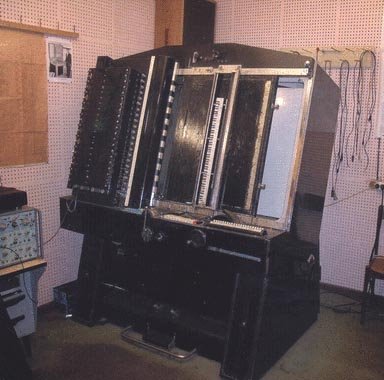
[Image: The ANS].
The ANS functioned through an "array of tiny chisels" that engraved "lines and points on rotating black enamelled glass discs." These engravings would then "regulate the brightness of light rays" that passed "through the discs onto photoelements," like the sun streaming through carefully shaded windows.
The "level of intensity" of this light then produced specific sounds.
Elsewhere (scroll down in this link till you hit the COILANS review), we read about the ANS's unique compositional process: "The composer inscribes his visual 'score' onto a glass plate covered with sticky black mastic, slides it through the machine, which reads the inscribed plate and converts the etchings into sound produced by a system of 800 oscillators."
It's a machine that reads windows.

[Image: A representative musical score for the ANS – but what if you fed it architectural diagrams?].
The Wire then explains that, in 2002, British band Coil visited the synthesizer in Moscow and recorded nearly 4 hours of music using the machine. Listening to what they produced, we're told, sounds "like travelling through the Oort Cloud or the Kuiper Belt – glitting slivers of distant white light and vast, nebulous spaces populated by inchoate radioactive matter." As you'll notice in these three, 3-minute samples, the effect is certainly weird – but unbelievably mesmerizing: 1, 2, and 3 (all MP3s).
Light, chisels, glass plates, oscillators, enamelled surfaces, engravings on windows – with these elements it is not at all hard to imagine a kind of ANS architecture, rebuilt on the scale of a building. Windowed lobbies and escalators; sunlight; entire lift shafts full of glass discs, inscribed and black-enamelled, emitting music like light. Whole rooms of sound, angelic, the windows slightly trembling.
Moving panes of glass, washed clean at the end of the day, pass slowly behind curtains, casting shadows.
A symphony for glass escalators. Chamber music.
Entire cities, made from nothing but windows, tuning to each other – like the sound of orchestral sunlight.
(Note: The ANS was apparently used to soundtrack Andrei Tarkovsky's films Solaris and Stalker).
from bldgblog
[Image: The ANS].
The ANS functioned through an "array of tiny chisels" that engraved "lines and points on rotating black enamelled glass discs." These engravings would then "regulate the brightness of light rays" that passed "through the discs onto photoelements," like the sun streaming through carefully shaded windows.
The "level of intensity" of this light then produced specific sounds.
Elsewhere (scroll down in this link till you hit the COILANS review), we read about the ANS's unique compositional process: "The composer inscribes his visual 'score' onto a glass plate covered with sticky black mastic, slides it through the machine, which reads the inscribed plate and converts the etchings into sound produced by a system of 800 oscillators."
It's a machine that reads windows.

[Image: A representative musical score for the ANS – but what if you fed it architectural diagrams?].
The Wire then explains that, in 2002, British band Coil visited the synthesizer in Moscow and recorded nearly 4 hours of music using the machine. Listening to what they produced, we're told, sounds "like travelling through the Oort Cloud or the Kuiper Belt – glitting slivers of distant white light and vast, nebulous spaces populated by inchoate radioactive matter." As you'll notice in these three, 3-minute samples, the effect is certainly weird – but unbelievably mesmerizing: 1, 2, and 3 (all MP3s).
Light, chisels, glass plates, oscillators, enamelled surfaces, engravings on windows – with these elements it is not at all hard to imagine a kind of ANS architecture, rebuilt on the scale of a building. Windowed lobbies and escalators; sunlight; entire lift shafts full of glass discs, inscribed and black-enamelled, emitting music like light. Whole rooms of sound, angelic, the windows slightly trembling.
Moving panes of glass, washed clean at the end of the day, pass slowly behind curtains, casting shadows.
A symphony for glass escalators. Chamber music.
Entire cities, made from nothing but windows, tuning to each other – like the sound of orchestral sunlight.
(Note: The ANS was apparently used to soundtrack Andrei Tarkovsky's films Solaris and Stalker).
from bldgblog
Urban Sound Walks
"In 2003," Cabinet Magazine tells us, "Berlin-based sound artist Christina Kubisch began an ongoing project called 'Electrical Walks.'"
For this project, Kubisch has employed "specially built headphones that receive electromagnetic signals from the environment," transforming those signals "into sound." In the process, "Kubisch maps a given territory, noting 'hot spots' (ATM machines, security systems, electronic cash registers, subway systems, etc.) where the signals are particularly strong or interesting." In other words, she performs a kind of audial psychogeography, zones of the city turned into MP3s, "very beautiful, very dense sounds... like a movie, an audio movie."
The images, below, represent the sound files those sounds produced, digital noise-maps of urban space.

Whether you're listening to the mellow, down-tempo techno of this light advertisement from Japan, or the sci-fi drone of a Taiwanese subway (which Cabinet covertly, and somewhat fascistically, editorializes as a region of China) – or even the minimal, repetitive heartbeat of this security gate in Oxford, England, the mournful buzz of a Bratislava tram, which Kubisch describes as "almost like a choir," or the empty Ballardian hum of a control tower at Heathrow airport – these are the electromagnetic sounds of modern urbanism.
"What I would really like to do," Kubisch says, "is to make a map of several cities and continents. In a large city, for example, where are the electromagnetic fields? Where are the security gates? You could just mark them with little dots. They even have the same sound systems all over the world. It's the globalization of sound. This is something that I think would be very interesting: to see a network of little dots showing where things are and where they are spreading. Every time I do an 'Electrical Walk,' it adds to this general map of sound that I'm collecting. It's artistic work, but it's a kind of social research, too."
There are thirty tracks in all. Knock yourself out.
(Related and elsewhere: we make money not art discusses Kubisch's project as well as "sound performances produced by people scanning their Oyster cards as they access London tube stations.")
from bldgblog
For this project, Kubisch has employed "specially built headphones that receive electromagnetic signals from the environment," transforming those signals "into sound." In the process, "Kubisch maps a given territory, noting 'hot spots' (ATM machines, security systems, electronic cash registers, subway systems, etc.) where the signals are particularly strong or interesting." In other words, she performs a kind of audial psychogeography, zones of the city turned into MP3s, "very beautiful, very dense sounds... like a movie, an audio movie."
The images, below, represent the sound files those sounds produced, digital noise-maps of urban space.
Whether you're listening to the mellow, down-tempo techno of this light advertisement from Japan, or the sci-fi drone of a Taiwanese subway (which Cabinet covertly, and somewhat fascistically, editorializes as a region of China) – or even the minimal, repetitive heartbeat of this security gate in Oxford, England, the mournful buzz of a Bratislava tram, which Kubisch describes as "almost like a choir," or the empty Ballardian hum of a control tower at Heathrow airport – these are the electromagnetic sounds of modern urbanism.
"What I would really like to do," Kubisch says, "is to make a map of several cities and continents. In a large city, for example, where are the electromagnetic fields? Where are the security gates? You could just mark them with little dots. They even have the same sound systems all over the world. It's the globalization of sound. This is something that I think would be very interesting: to see a network of little dots showing where things are and where they are spreading. Every time I do an 'Electrical Walk,' it adds to this general map of sound that I'm collecting. It's artistic work, but it's a kind of social research, too."
There are thirty tracks in all. Knock yourself out.
(Related and elsewhere: we make money not art discusses Kubisch's project as well as "sound performances produced by people scanning their Oyster cards as they access London tube stations.")
from bldgblog
Dolby Earth / Tectonic Surround-Sound
"In any given instant," the Discovery Channel reminds us, "one or more rocky plates beneath Earth's surface are in motion, and now visitors to a California museum exhibit can hear virtually every big and small earthquake simultaneously in just a few seconds off real time. Scientists have captured earthquake noises before, but this is believed to be the first instantaneous, unified recording of multiple global tectonic events, and it sounds like the constant, dull roar of the world's biggest earthquake chorus."
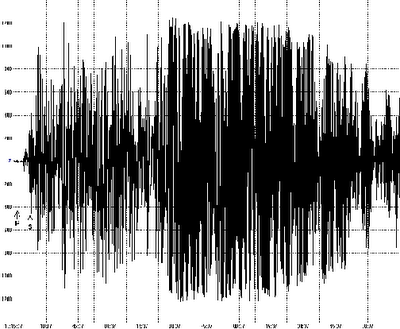
The planet, droning like a bell in space.
Of course, the musicalization of the earth's tectonic plates has come up on BLDGBLOG before, specifically in the context of 9/11 and the collapse of the Twin Towers. Among many other things, 9/11 was an architectural event which shook the bedrock of Manhattan; the resulting vibrations were turned into a piece of abstract music by composer Mark Bain (more info at the Guardian – and you can listen to an excerpt here).
Meanwhile, if somebody set up a radio station – perhaps called Dolby Earth – permanently dedicated to realtime platecasts of the earth's droning motions... at the very least I'd be a dedicated listener.
A glimpse of what could have been: Earth: The Peel Sessions.
In any case, if I could also remind everyone here of an interview with David Ulin, in which he discusses the intellectual and philosophical perils of earthquake prediction – the topic of his excellent book, The Myth of Solid Ground. One of the predictors, for instance, discussed in Ulin's book, spends his time "monitoring a symphony of static coming from an elaborate array of radios tuned between stations at the low end of the dial."
Dolby Earth, indeed.
(Thanks to Alex P. for the Discovery Channel link! Related: Sound Dunes)
from bldgblog
The planet, droning like a bell in space.
Of course, the musicalization of the earth's tectonic plates has come up on BLDGBLOG before, specifically in the context of 9/11 and the collapse of the Twin Towers. Among many other things, 9/11 was an architectural event which shook the bedrock of Manhattan; the resulting vibrations were turned into a piece of abstract music by composer Mark Bain (more info at the Guardian – and you can listen to an excerpt here).
Meanwhile, if somebody set up a radio station – perhaps called Dolby Earth – permanently dedicated to realtime platecasts of the earth's droning motions... at the very least I'd be a dedicated listener.
A glimpse of what could have been: Earth: The Peel Sessions.
In any case, if I could also remind everyone here of an interview with David Ulin, in which he discusses the intellectual and philosophical perils of earthquake prediction – the topic of his excellent book, The Myth of Solid Ground. One of the predictors, for instance, discussed in Ulin's book, spends his time "monitoring a symphony of static coming from an elaborate array of radios tuned between stations at the low end of the dial."
Dolby Earth, indeed.
(Thanks to Alex P. for the Discovery Channel link! Related: Sound Dunes)
from bldgblog
1.02.2009
Sound dunes
"Sand dunes in certain parts of the world are notorious for the noises they make," the New Scientist reports, "as sand avalanches down their sides. Some [dunes] emit low powerful booms, others sound like drum rolls or galloping horses, and some are even tuneful. These dune songs have been reported to last for up to 15 minutes and can sound as loud as a low-flying aeroplane."
To test for the causes, properties, and other effects of these sand dune booms, "Stéphane Douady of the French national research agency CNRS and his colleagues shipped sand from Moroccan singing dunes back to his lab to investigate."

A miniature landscape, cut from the whole, DHL'd back to the home lab for testing.
There, Douady's team "found that they could play notes by pushing the sand by hand, or with a metal handle."
The transformation of a sand dune – and, by extension, the entire Sahara desert, indeed any desert – even, by extension, the rust deserts of Mars – into a musical instrument.
Music of the spheres, indeed.
"When the sand avalanches, the grains jostle each other at different frequencies, setting up standing waves in the cascading layer, says Douady. These waves reinforce one another, making the layer vibrate like the surface of a loud speaker. 'What's funny is that in these massive dunes, only a thin layer of 2 or 3 centimetres is needed to set up the resonance,' says Douady. 'Soon all grains begin to vibrate in step.'"
Douady has so perfected his technique of dune resonance that he has now "successfully predicted the notes emitted by dunes in Morocco, Chile and the US simply by measuring the size of the grains they contain." The music of the dunes, in other words, was determined entirely by the size, shape, and roughness of the sand grains involved, where excessive smoothness dampened the dunes' sound.

I'm reminded of the coast of Inishowen, a peninsula south of Malin Head in the north of Ireland, where the rocks endlessly grind across one another in the backwash of heaving, metallic, grey Atlantic waves. Under constant pressure of the oceanic, the rocks carve into themselves and each other, chipping down over decades into perfectly polished and rounded spheres, columns, and eggs – as if Archimedean solids or the nested orbits of Kepler could be discovered on the Irish ocean foreshore –
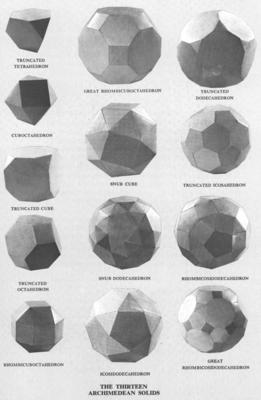
– all glittering. The rocks, I later learned, were actually semi-precious stones, and I had a kind of weird epiphany, standing there above the hush and clatter of bejewelled rocks, rubbing and rubbed one to the other in the depopulated void of a coastal November. It was not a sound easy to forget.
Because the earth itself is already a musical instrument: there is "a deep, low-frequency rumble that is present in the ground even when there are no earthquakes happening. Dubbed the 'Earth's hum', the signal had gone unnoticed in previous studies because it looked like noise in the data."
Elsewhere: "Competing with the natural emissions from stars and other celestial objects, our Earth sings like a canary – it drones on in a constant hum of a gazillion notes. If it were several octaves higher, and hence, audible to the human ear," it could probably get recorded by the unpredictably omnidirectional antennas of ShortWaveMusic and... you could download the sound of the earth.
Free Radio Interterrestrial.
[Note: the "drones on" link, a sentence or two back, offers a contrary theory (published in 2000) about the origins of these planetary soundwaves.]
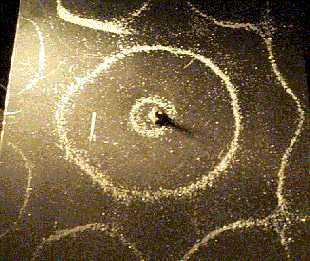
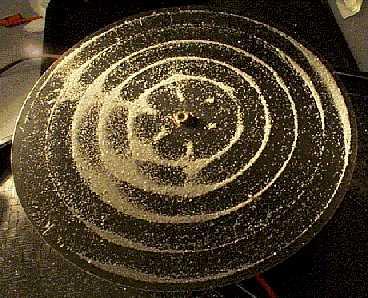
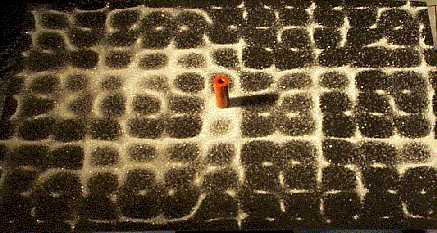
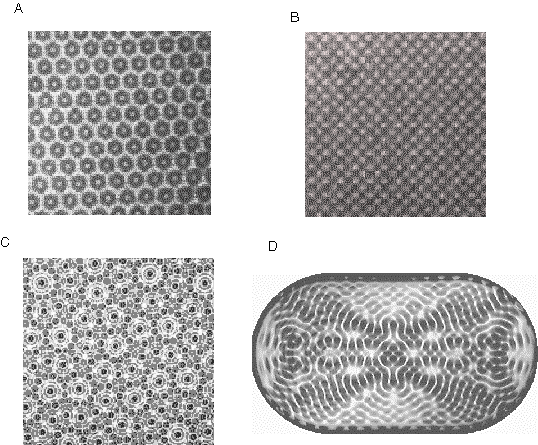
Which, finally, brings us to Ernst Chladni and his Chladni figures, or: architectonic structures appearing in sand due to patterns of acoustic resonance.
Architecture through sound, involving sand. Silicon assuming structure. Desert harddrive, humming.
The gist of Chladni's experiments involved spreading a thin layer of sand across a vibrating plate, changing the frequency at which the plate vibrated, and then watching the sand as it shivered round, forming regular, highly geometric patterns. Those patterns depended upon, and were formed in response to, whatever vibration frequency it was that Chladni chose.
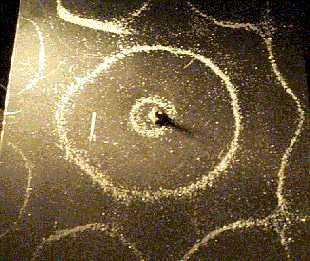
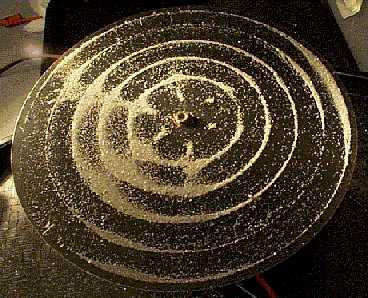
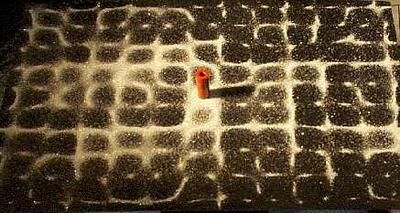
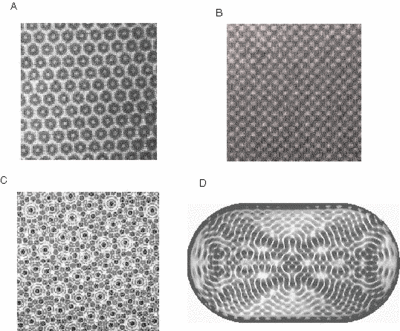
So you've got sand, dune music, terrestrial vibration, some Chladni figures – one could be excused for wondering whether the earth, apparently a kind of carbon-ironic bell made of continental plates and oceanic resonators, is really a vast Chladni plate, vibrating every little mineral, every pebble, every grain of sand, perhaps every organic molecule, into complex, three-dimensional, time-persistent patterns for which we have no standard or even technique of measurement. Or maybe William Blake knew how to do it, or Pythagoras, or perhaps even Nicola Tesla, but...
The sound dunes continue to boom and shiver. The deserts roar. The continents hum.
from bldgblog
To test for the causes, properties, and other effects of these sand dune booms, "Stéphane Douady of the French national research agency CNRS and his colleagues shipped sand from Moroccan singing dunes back to his lab to investigate."

A miniature landscape, cut from the whole, DHL'd back to the home lab for testing.
There, Douady's team "found that they could play notes by pushing the sand by hand, or with a metal handle."
The transformation of a sand dune – and, by extension, the entire Sahara desert, indeed any desert – even, by extension, the rust deserts of Mars – into a musical instrument.
Music of the spheres, indeed.
"When the sand avalanches, the grains jostle each other at different frequencies, setting up standing waves in the cascading layer, says Douady. These waves reinforce one another, making the layer vibrate like the surface of a loud speaker. 'What's funny is that in these massive dunes, only a thin layer of 2 or 3 centimetres is needed to set up the resonance,' says Douady. 'Soon all grains begin to vibrate in step.'"
Douady has so perfected his technique of dune resonance that he has now "successfully predicted the notes emitted by dunes in Morocco, Chile and the US simply by measuring the size of the grains they contain." The music of the dunes, in other words, was determined entirely by the size, shape, and roughness of the sand grains involved, where excessive smoothness dampened the dunes' sound.

I'm reminded of the coast of Inishowen, a peninsula south of Malin Head in the north of Ireland, where the rocks endlessly grind across one another in the backwash of heaving, metallic, grey Atlantic waves. Under constant pressure of the oceanic, the rocks carve into themselves and each other, chipping down over decades into perfectly polished and rounded spheres, columns, and eggs – as if Archimedean solids or the nested orbits of Kepler could be discovered on the Irish ocean foreshore –
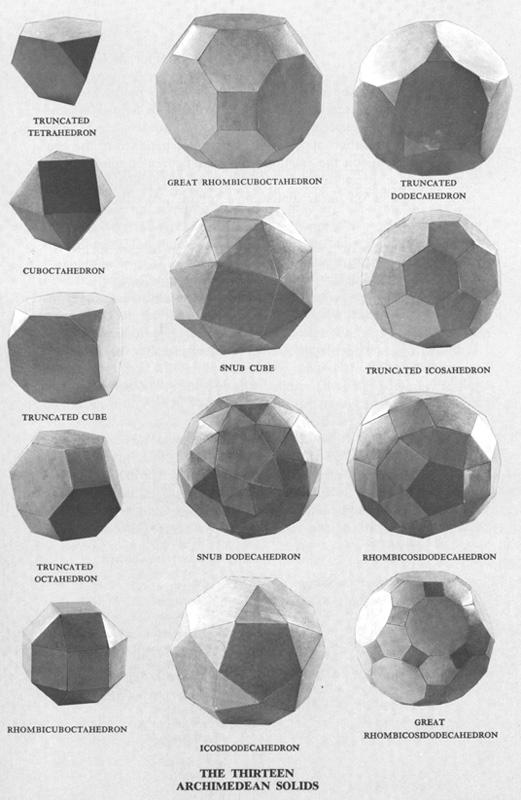
– all glittering. The rocks, I later learned, were actually semi-precious stones, and I had a kind of weird epiphany, standing there above the hush and clatter of bejewelled rocks, rubbing and rubbed one to the other in the depopulated void of a coastal November. It was not a sound easy to forget.
Because the earth itself is already a musical instrument: there is "a deep, low-frequency rumble that is present in the ground even when there are no earthquakes happening. Dubbed the 'Earth's hum', the signal had gone unnoticed in previous studies because it looked like noise in the data."
Elsewhere: "Competing with the natural emissions from stars and other celestial objects, our Earth sings like a canary – it drones on in a constant hum of a gazillion notes. If it were several octaves higher, and hence, audible to the human ear," it could probably get recorded by the unpredictably omnidirectional antennas of ShortWaveMusic and... you could download the sound of the earth.
Free Radio Interterrestrial.
[Note: the "drones on" link, a sentence or two back, offers a contrary theory (published in 2000) about the origins of these planetary soundwaves.]
Which, finally, brings us to Ernst Chladni and his Chladni figures, or: architectonic structures appearing in sand due to patterns of acoustic resonance.
Architecture through sound, involving sand. Silicon assuming structure. Desert harddrive, humming.
The gist of Chladni's experiments involved spreading a thin layer of sand across a vibrating plate, changing the frequency at which the plate vibrated, and then watching the sand as it shivered round, forming regular, highly geometric patterns. Those patterns depended upon, and were formed in response to, whatever vibration frequency it was that Chladni chose.
So you've got sand, dune music, terrestrial vibration, some Chladni figures – one could be excused for wondering whether the earth, apparently a kind of carbon-ironic bell made of continental plates and oceanic resonators, is really a vast Chladni plate, vibrating every little mineral, every pebble, every grain of sand, perhaps every organic molecule, into complex, three-dimensional, time-persistent patterns for which we have no standard or even technique of measurement. Or maybe William Blake knew how to do it, or Pythagoras, or perhaps even Nicola Tesla, but...
The sound dunes continue to boom and shiver. The deserts roar. The continents hum.
from bldgblog
订阅:
博文 (Atom)