BBC 中文网 | 时事专题 | Pundit Commentary | 中国农村地区生态环境状况令人担忧:
"中国农村地区生态环境继续恶化,主要表现在:
第一:城市的工业污染急剧向农村扩散;
第二:农业生产所使用的化肥、杀虫剂等对于土地和水体的污染依然持续;
第三:农村饮用水存在安全隐患,3亿多农村居民没有安全清洁的饮用水;
第四:自然生态继续恶化,沙漠化、次沙漠化、水土流失、湿地消失的趋势未能得到控制。
最近几年以来,有大量的污染企业或者是会产生大量的污染的产品从城市向农村转移。由于城居民的生态环保意识得到加强,迫使许多污染企业在不改造的前提下无法在城市继续生存下去。中国政府也在实际措施中鼓励污染企业从人口密集的城市向人口稀疏的农村转移。比如北京为了举办奥运会,将北京城中的污染企业迁到邻近的省区。因此各省区也纷纷仿效北京的做法,把污染企业从省会城市向农村转移。
在二十世纪的七、八十年代,工业发达国家也曾经把污染企业从城市转移到农村地区,期望能以此解决环境污染问题。但是不久他们就发现,这样做的后果不是减小了污染,而是扩大了污染,最终结果是不利于治理污染。因为农村地区人口较少,所能施加的政治压力也小。之后他们就放弃了这种做法(但是没有放弃把污染企业向发展中国家转移),而是坚持在当地进行改造,减少污染的排放。而中国目前则是继续工业发达国家曾经犯过的错误。在中国这种做法的危害更大。在西方社会中,农村人口的文化素质和环保意识和城里人没有区别,而在中国,农村人口的文化水平低,对环境污染危害的认识也比不上城里人。况且他们大部份人又不享受医疗保险,一旦遭到污染危及健康,后果十分严重。
业绩下的牺牲者
在中国,农村地区的党政官员为了创造业绩,牺牲当地农民的利益,积极引进污染企业,目的只有一个,提高县镇的GDP的发展速度,为自己的升官晋级提供敲门砖。他们最常用的说法就是,环境保护不能阻碍经济发展,环境保护不能妨碍发财致富。
最近暴露出来的云南省阳宗海水体污染事件,就是一个污染向农村转移的典型例子。造成这次水体污染的是云南澄江锦业工贸有限公司的一个化工厂,这是一个私有化了的镇办企业。他们生产的就是从城市向农村转移的有污染的化工产品。生产这种产品GDP高,所以是当地政府保护的'大企业'。该产品在生产过程中会产生大量含砷的废水。砷就是老百姓所说的砒霜。潘金莲害死武大郎用的就是砒霜。砷及其含砷化合物毒性很强,对人、蓄的健康有很大影响。砷化物主要损伤人体的神经系统、肝脏、皮肤等,可以致癌。
这些含砷的废水进入了湖泊,造成了水体的砷污染。据报导,该化工厂排出的废水中总共含砷67公斤!要是潘金莲有67公斤砷,能害死多少武大郎?世界卫生组织饮用水水质标准规定砷的浓度不能超过0.01mg/l,而在该公司阳宗海取水口以南25米处泉眼砷含量高达67.7毫克/升,竟为世界卫生组织饮用水水质标准的6770倍!
湖泊周围的居民,特别是渔民,常年就是直接饮用湖泊中的水。渔民以为只有水混才是被'搞脏'了,被污染了。他们根本不知道象砷这类有害物质的污染,并不会把水搞脏,但是其所含物质则是剧毒的。当地的环保部门设备简单,没有检测水中含砷物质的实验室设备,取到水样还需送到省城去化验,监测水质部份还是靠肉眼。
这样,在当地居民毫不知情的情况下,他们足足喝了三个多月含砷量超标的水,人体健康受到危害。
要改变中国农村地区生态环境恶劣的现状,中国政府必须采取确实有效的措施,当务之急,就是禁止再把污染企业或者是会产生大量的污染的产品从城市向农村转移。"
2.01.2009
1.09.2009
Deserted
 [Image: Photo by Benoit Aquin for Walrus Magazine].
I came across an article just today called "The Chinese Dust Bowl," published last October in Canada's Walrus Magazine (a great magazine – don't miss their look at New York City flood barriers).
The accompanying photographs of dust storms, ruined crops, dead forests, and hazed-over city squares, taken by Benoit Aquin, are really fantastic – and you can look at a complete PDF of the article here.
For the article, author Patrick Alleyn rode something called the K43-T69 train west from Beijing to explore the seemingly relentless process of Chinese desertification. "A few hours after the train leaves Beijing," he writes, "a lunar black mountain range welcomes passengers into a vast arid landscape."
 [Image: Photo by Benoit Aquin for Walrus Magazine].
This is what Alleyn refers to as "the Chinese Dust Bowl" – "a dreamscape of steppes and deserts" – which is "probably the largest conversion of productive land into sand anywhere in the world."
- To date, Chinese farmers and herders have transformed about 400,000 square kilometres of cropland and verdant prairie into new deserts. The shepherds have overgrazed the steppes, allowing their sheep and goats to chew the grass all the way down to its roots. The farmers, for their part, have over-exploited the arable land by opening fragile grasslands to cultivation and over-pumping rivers and aquifers in the oases bordering the ancient deserts. The area of desert thus created is equivalent to more than half the farmland in Canada.
標籤:
china china china,
image,
our earth

1.03.2009


The residual landscape (China)
I've already posted two photographs by Edward Burtynsky (see "Naxos Quarries"), but I went clicking back through his site last night and decided to add some more, this time expanding BLDGBLOG's ongoing exploration of space in China.
Here, then, are photographs of factories, from Burtynsky's Manufacturing series, and they're so strikingly self-similar and excessively color-coded they look like IKEA assembly plants, not factories at all.
Take a look:
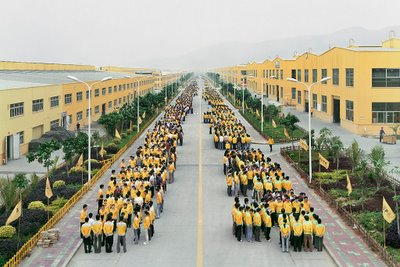

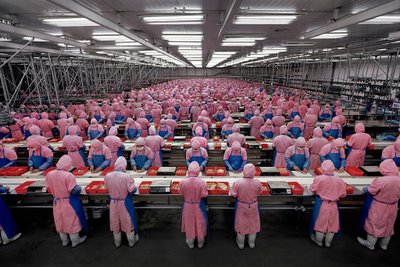

[Images: From top to bottom: "Manufacturing #18, Cankun Factory, Zhangzhou, Fujian Province" (2005); "Manufacturing #16, Bird Mobile, Ningbo, Zhejiang Province" (2005); "Manufacturing #17,Deda Chicken Processing Plant, Dehui City, Jilin Province" (2005); and "Manufacturing #11, Youngor Textiles, Ningbo, Zhejiang Province" (2005) – and substantially larger versions are available if you click on them].
Burtynsky uses photography to explore what he calls "the residual landscape," or the geo-cultural margins of "the great ages of man; from stone, to minerals, oil, transportation, silicon, and so on."
And some of his images are so stunning I might post a few more soon...
Here, then, are photographs of factories, from Burtynsky's Manufacturing series, and they're so strikingly self-similar and excessively color-coded they look like IKEA assembly plants, not factories at all.
Take a look:

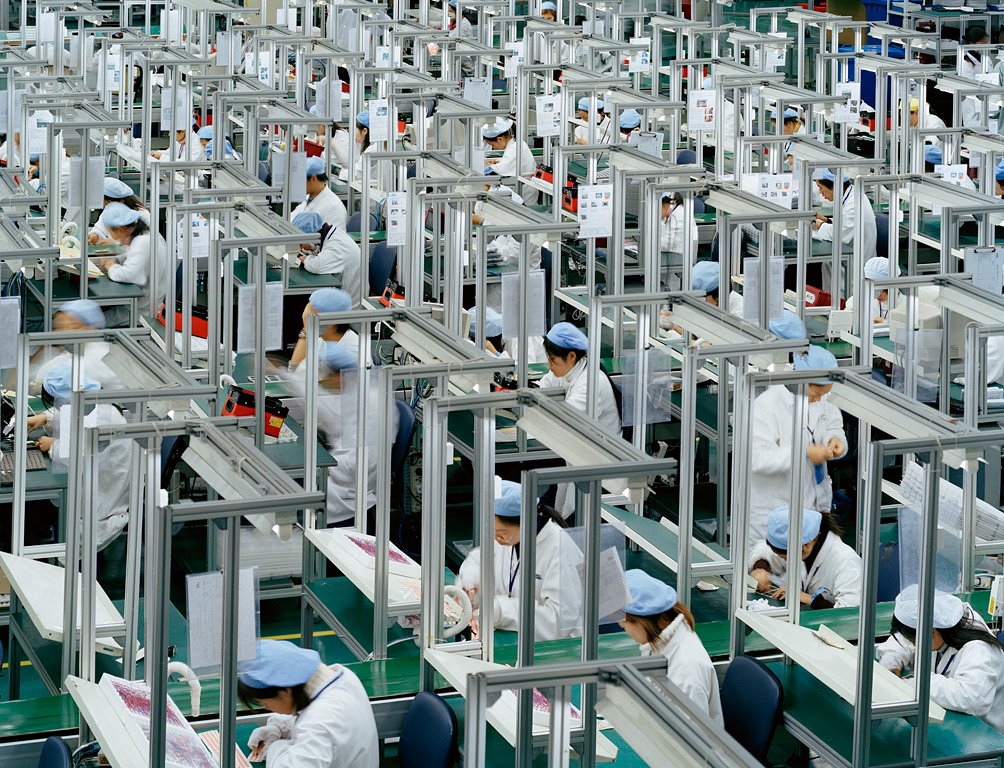


[Images: From top to bottom: "Manufacturing #18, Cankun Factory, Zhangzhou, Fujian Province" (2005); "Manufacturing #16, Bird Mobile, Ningbo, Zhejiang Province" (2005); "Manufacturing #17,Deda Chicken Processing Plant, Dehui City, Jilin Province" (2005); and "Manufacturing #11, Youngor Textiles, Ningbo, Zhejiang Province" (2005) – and substantially larger versions are available if you click on them].
Burtynsky uses photography to explore what he calls "the residual landscape," or the geo-cultural margins of "the great ages of man; from stone, to minerals, oil, transportation, silicon, and so on."
And some of his images are so stunning I might post a few more soon...
標籤:
china china china,
image
Space in China

[Image: Causeway Bay I, Hong Kong, 2004, by Sze Tsung Leong.]
It was quietly announced, at the end of August, that Arup, the almost comically omnipresent British engineering firm, has won a multi-billion pound contract for the design, engineering, and construction of an entire city, to be built from scratch outside Shanghai in the Dongtan wetlands of eastern China.
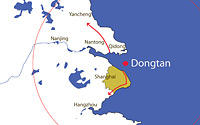
[Image from Arup's website.]
The city – called, simply, Dongtan – will be "the world’s first genuinely eco-friendly city," the Times reports, "powered by renewable energy sources and as close to carbon-neutral as possible."
It "will eventually extend to cover some 8,800 hectares, roughly equivalent to New York’s Manhattan island" – though Arup, it seems, will only be planning an initial "630 hectares, roughly three times the size of the City of London."
Only.
Arup's own press release spells out their role in great detail: "Arup is responsible for the integrated master-planning of the built environment... providing a full range of services, including urban design, planning, sustainable energy management, waste management, renewable energy process implementation, economic and business planning, sustainable building design, architecture, infrastructure and even the planning of communities and social structures." (Which, latterly, sounds rather ominous.)
"Priority projects [will] include the process of capturing and purifying water in the landscape to support life in the city. Community waste management recycling will generate clean energy from organic waste, reducing landfills that damage the environment. Combined heat and power systems will provide the technology to source clean and reliable energy."
Compare that to the hum-drum initiatives under discussion now to rebuild New Orleans, and you can't help but conclude that the United States is in such an advanced state of structural decrepitude and urban-imaginative bankruptcy that opening up a few branches of CVS or a Ross Dress For Less somehow passes for successful urbanism.
Dongtan, Arup claims, "underline[s] the Chinese government’s move to take account of environmental considerations in future policy initiatives."
Whether or not such optimism is warranted, it is interesting to read such a statement in light of an article that appeared last night in The Guardian. Its author, Jonathan Watts, suggests that "a much bleaker future" is in store for China's nascent, super-powered, high-construction economy: "Environmentally and spiritually," Watts writes, "[China's rapid development] is a disaster. China's rivers are drying up, its cities are choked with pollution, the rural health-care system has collapsed and the cities are seeing record levels of suicide and stress. China is showing all the symptoms of modernity – only on a bigger scale and at a faster rate than the world has ever seen."
One could argue, however, that this increasingly catastrophic situation is exactly why the Chinese government now seeks to build a city like Dongtan.
In any case, Watts ends with a kind of prescription: "In the 19th century, Britain and Europe taught the world how to produce. In the 20th, the US taught us how to consume. If China is to lead the world in the 21st century, it must teach us how to sustain."
I would here hesitantly suggest that Arup's involvement with Dongtan perhaps offers an odd, if very real – if not, in fact, utopian – source of inspiration for urbanists, environmentalists, and BLDGBLOG contributors the world over. I just really, deeply, and profoundly hope, with unabashed, wide-eyed American sincerity, that Dongtan has at least one Ross Dress For Less.
Returning to Watts – well, returning to the subject matter that Watts is actually discussing: the new Chinese railway to Tibet (in the context of other Chinese infrastructural projects now under construction) – we find some truly astonishing descriptions.
For instance (taken, really, from a pay-per-view New York Times article): "For long stretches the [Tibet-bound] railway, which is fast nearing completion, will operate at altitudes higher than many small planes can fly, huffing and puffing far above the fragrant mists that roll down the Himalayan slopes. Indeed, the train, whose engines will need turbochargers just to get enough oxygen to run, will often soar above the clouds." (See also Archinect).
Or this, from Watts: "Luxury trains are being built for the new track. They feature pressurised carriages to minimise the risk of altitude sickness [!] and tinted windows to protect from strong ultra-violet rays. (...) The cars will be pulled by diesel engines capable of maintaining an average speed of 100 kph, even at above 4,000m, when the thinness of the air can cut power by almost half."
Then there's the awe-inspiring geotechnical challenge, which begs the question of whether human beings are even meant to be there in the first place (I would think not): the railway will cross "a vast sea of permafrost that stretches more than 600km across the [Qinghai] plateau towards Tibet and the Himalayas, prompting some to describe this area as the third pole of the world." This "third pole" is also known as the earthquake-prone Kunlun Pass, where "[e]ven the best Swiss tunnelling engineers concluded that it was impossible to bore through the rock and ice."
Watts continues: "There were 5,000m-high mountains to climb, 12km-wide valleys to bridge, hundreds of kilometres of ice and slush that could never support tracks and trains. How could anyone tunnel through rock at -30C, or lay rails when the least exertion sends you reaching for the oxygen bottle? But that's the sort of challenge today's China relishes."
China, indeed, is a nation of infrastructure.
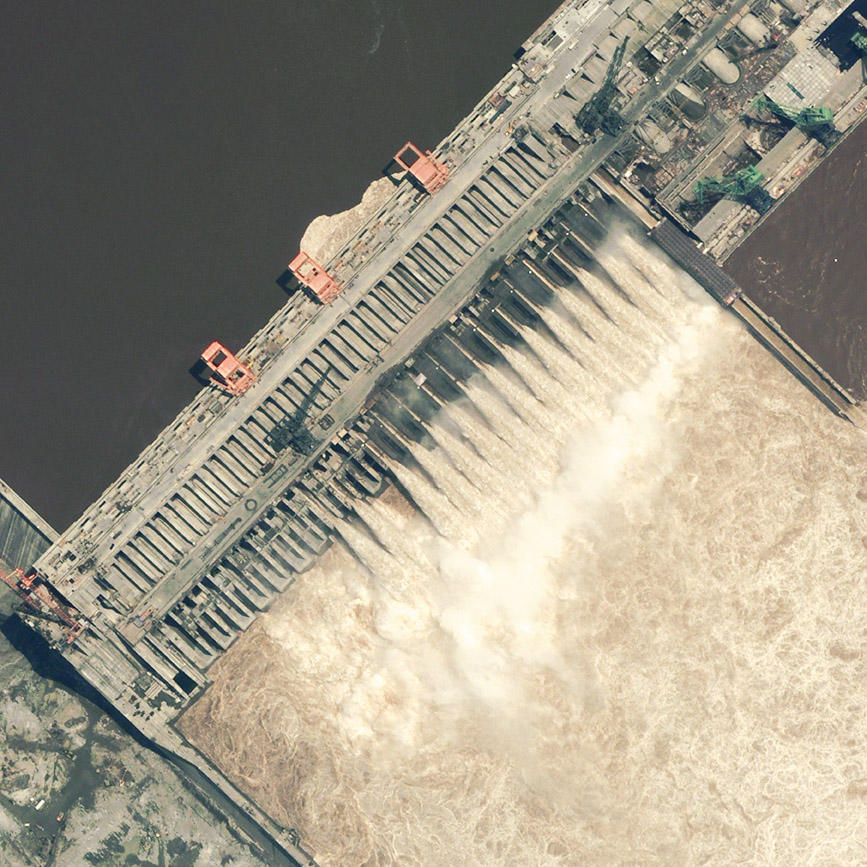
[Image: Three Gorges Dam, the largest hydroelectric dam on the planet and "China's biggest construction project since the Great Wall," Watts writes.]
See, for instance, China's new highway system.
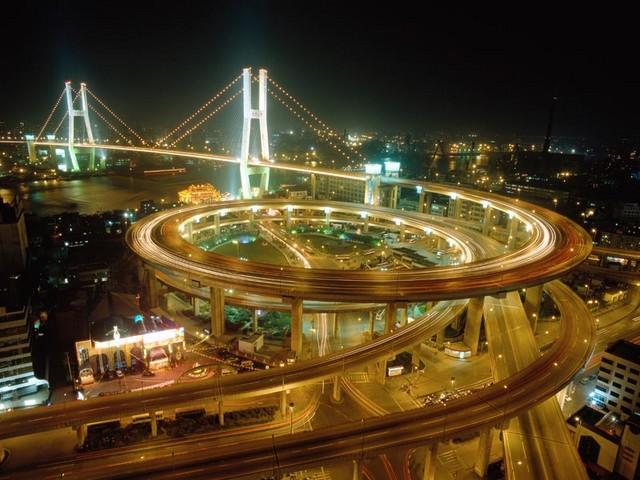
[Image: Shanghai gyratory (slideshow).]
From the BBC: "Every year China is constructing around 4,000 km of expressways, towards its target of connecting every city with a population of 200,000 or more to an 85,000 km national motorway network. Half the work is already done."
Will the Chinese produce their own Kerouac in 30 years? Riding the endless Chinese highways in a beat-up FAW, quoting St. Augustine and rewriting the Diamond Sutra?
Or will cars become obsolete just as China's national highway system is completed?
Come what may, a (now pay-per-view) article in the Engineering News-Record describes how, across bridges and inland piers, through tunnels and switchbacks, sinkholes and mines, across karst bedrock and the terrain of old wars, the Chinese highway system, come hell or high water – come permafrost or earthquakes – is being constructed.
So what's the point?
1) Several generations' worth of infrastructural planning and construction are occurring in China over the span of two decades.
2) The "eco-city" of Dongtan represents a positive model for urban design and development – shaming the United States, in particular, as libertarian pro-Bush anti-urbanists face having to rebuild New Orleans, in a flood zone, below sea level.
3) The Chinese highway and train systems, impressive enough (even if only on the level of national mythology), could have disastrous religious, cultural, and environmental impacts on the people of Tibet, the population of greater China – and perhaps on the global climate at large. This is something I've hardly even begun to discuss.
And yet it feels like the only real thing we can do for now is continue to watch space in China.

[Image: Beisihuanxi Lu, Zhongguancun, Haidian District, Beijing, 2004, by Sze Tsung Leong.]
from bldgblog
標籤:
china china china,
image
1.02.2009

订阅:
博文 (Atom)