2.27.2009
The Singing, Ringing Tree
Looking like the wreckage of an Alien space craft, this Futuristic Sculpture is Art Jim, but not as we know it. Commisioned by a forward thinking Burnley Council, The collection of tubes makes the strangest sounds when the wind blows, which is often round the location at Crown POint, on the moorland overlooking Burnley. Seen in the background is Pendle Hill, famous for the PENDLE WITCHES. Maybe in the sculpture, the myth lives on. Let me know what YOU think.
via http://www.youtube.com/watch?v=4B0hGyKV9qs

2.10.2009
maya lin at the de young museum, san francisco maya lin 'systematic landscapes' at: de young museum, san francisco, USA from: now - january 18, 2009 'systematic landscapes is a major exhibition of new sculptures, drawings, and installations by artist maya lin. in recent years, lin has focused on a reconsideration of landscape in a time of ecological tension and change. this body of work engages the issue of our fragile connection to the environment in timely and poetic ways.'  'waterline' 2006  '2x4 landscape' 2006  '2x4 landscape' 2006  'blue lake pass' 2006  'pin river' 2006  piece from the 'bodies of water' series, 2006  piece from the 'bodies of water' series, 2006 the exhibition's website features a lengthy video of lin explaining the pieces from 'systematic landscapes' along with tons of behind the scenes photos. more maya lin: http://www.mayalin.comde young museum: http://www.famsf.org via designboom |
2.03.2009
Numark's PT01 Turntables as Art
Sean Duffy's art installation goes beyond just music
Curators at art museums usually tell you not to touch a thing, but one exhibit on display at the Arizona State University Art Museum is all hands-on with Numark PT-01 Portable Turntables. KJZZ's Rene Gutel's has the story about "The Grove."
Here's the video:
1.09.2009
Space as a Symphony of Turning Off Sounds
In David Toop's classic book Ocean of Sound – something I cite repeatedly here on BLDGBLOG – we read about a musical performance that, by accident of circumstance, became a process of turning off all sources of noise within a building.
 [Image: Felix Hess assembles similar sound machines, next to a photo of an unrelated concert hall].
For an installation of fifty specially made "sound creatures" – little interactive robots "inspired by the communication eco-system of frog choruses," Toop writes – experimental musician Felix Hess insisted that there be no "extraneous sounds" in the concert hall. Hess's miniature sound performance required absolute silence, or else the machines would not function.
Toop then quotes a lengthy description of the creatures' set-up:
You could even turn it into a game:
Gradually they go on to turn off the entire world, street by street, city by city, in an ever-expanding ring of total silence.
The world becomes a sonic sculpture from which sources of background sound are constantly removed.
Finally, twenty-five years from now, as the very last radio is unplugged in a distant house in Tanzania, the "sound creatures" sitting with Felix Hess on stage begin singing.
[Image: Felix Hess assembles similar sound machines, next to a photo of an unrelated concert hall].For an installation of fifty specially made "sound creatures" – little interactive robots "inspired by the communication eco-system of frog choruses," Toop writes – experimental musician Felix Hess insisted that there be no "extraneous sounds" in the concert hall. Hess's miniature sound performance required absolute silence, or else the machines would not function.
Toop then quotes a lengthy description of the creatures' set-up:
- We had imagined that the foyer, on an afternoon when nothing was being held there, was extremely tranquil, but not even one of them began to call out in response to any of the others. So first we turned off the air conditioner in the room, and then we turned off the one on the second floor. Then we turned off the refrigerator and the electric cooking equipment in the adjoining cafe, the power of the multi-vision in the foyer, and the power of the vending machine in a space about ten metres away. One by one we took away these continual noises, which together created a kind of drone there... Hess was very interested in this and said things like, "From now on maybe I should do a performance of turning off sounds."
You could even turn it into a game:
- 1) You are sitting on a stage, wearing a blind-fold.
2) Every electrical device in the building around you is on.
3) Suddenly, you detect a slight difference, a vague change in sonic pressure somewhere, as if an extremely distant mosquito has been swatted – a spot of silence, as it were, has appeared in the room.
4) "Toaster, fourth floor!" you call out – and you're right. Someone turned off the toaster.
5) You win a trip to France.
Gradually they go on to turn off the entire world, street by street, city by city, in an ever-expanding ring of total silence.
The world becomes a sonic sculpture from which sources of background sound are constantly removed.
Finally, twenty-five years from now, as the very last radio is unplugged in a distant house in Tanzania, the "sound creatures" sitting with Felix Hess on stage begin singing.
1.04.2009
Listening to a machine made entirely from windows
An old issue of The Wire introduces us to a synthesizer called the ANS, built in 1950s Moscow by Eugene Murzin and "constructed around a unique and incredibly intricate photoelectronic system."
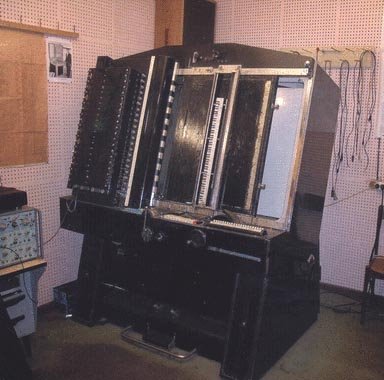
[Image: The ANS].
The ANS functioned through an "array of tiny chisels" that engraved "lines and points on rotating black enamelled glass discs." These engravings would then "regulate the brightness of light rays" that passed "through the discs onto photoelements," like the sun streaming through carefully shaded windows.
The "level of intensity" of this light then produced specific sounds.
Elsewhere (scroll down in this link till you hit the COILANS review), we read about the ANS's unique compositional process: "The composer inscribes his visual 'score' onto a glass plate covered with sticky black mastic, slides it through the machine, which reads the inscribed plate and converts the etchings into sound produced by a system of 800 oscillators."
It's a machine that reads windows.

[Image: A representative musical score for the ANS – but what if you fed it architectural diagrams?].
The Wire then explains that, in 2002, British band Coil visited the synthesizer in Moscow and recorded nearly 4 hours of music using the machine. Listening to what they produced, we're told, sounds "like travelling through the Oort Cloud or the Kuiper Belt – glitting slivers of distant white light and vast, nebulous spaces populated by inchoate radioactive matter." As you'll notice in these three, 3-minute samples, the effect is certainly weird – but unbelievably mesmerizing: 1, 2, and 3 (all MP3s).
Light, chisels, glass plates, oscillators, enamelled surfaces, engravings on windows – with these elements it is not at all hard to imagine a kind of ANS architecture, rebuilt on the scale of a building. Windowed lobbies and escalators; sunlight; entire lift shafts full of glass discs, inscribed and black-enamelled, emitting music like light. Whole rooms of sound, angelic, the windows slightly trembling.
Moving panes of glass, washed clean at the end of the day, pass slowly behind curtains, casting shadows.
A symphony for glass escalators. Chamber music.
Entire cities, made from nothing but windows, tuning to each other – like the sound of orchestral sunlight.
(Note: The ANS was apparently used to soundtrack Andrei Tarkovsky's films Solaris and Stalker).
from bldgblog
[Image: The ANS].
The ANS functioned through an "array of tiny chisels" that engraved "lines and points on rotating black enamelled glass discs." These engravings would then "regulate the brightness of light rays" that passed "through the discs onto photoelements," like the sun streaming through carefully shaded windows.
The "level of intensity" of this light then produced specific sounds.
Elsewhere (scroll down in this link till you hit the COILANS review), we read about the ANS's unique compositional process: "The composer inscribes his visual 'score' onto a glass plate covered with sticky black mastic, slides it through the machine, which reads the inscribed plate and converts the etchings into sound produced by a system of 800 oscillators."
It's a machine that reads windows.

[Image: A representative musical score for the ANS – but what if you fed it architectural diagrams?].
The Wire then explains that, in 2002, British band Coil visited the synthesizer in Moscow and recorded nearly 4 hours of music using the machine. Listening to what they produced, we're told, sounds "like travelling through the Oort Cloud or the Kuiper Belt – glitting slivers of distant white light and vast, nebulous spaces populated by inchoate radioactive matter." As you'll notice in these three, 3-minute samples, the effect is certainly weird – but unbelievably mesmerizing: 1, 2, and 3 (all MP3s).
Light, chisels, glass plates, oscillators, enamelled surfaces, engravings on windows – with these elements it is not at all hard to imagine a kind of ANS architecture, rebuilt on the scale of a building. Windowed lobbies and escalators; sunlight; entire lift shafts full of glass discs, inscribed and black-enamelled, emitting music like light. Whole rooms of sound, angelic, the windows slightly trembling.
Moving panes of glass, washed clean at the end of the day, pass slowly behind curtains, casting shadows.
A symphony for glass escalators. Chamber music.
Entire cities, made from nothing but windows, tuning to each other – like the sound of orchestral sunlight.
(Note: The ANS was apparently used to soundtrack Andrei Tarkovsky's films Solaris and Stalker).
from bldgblog
12.14.2008
représantation des objet sonnore

| Art Letter (4/24/08) |

Waffle Bike, 2008
And Waffle Bike! Sachs has even crafted a mighty waffle-maker-bicycle, complete with a mini-fridge, a cage for chicken to lay fresh eggs as well as components to hold ingredients like whipped cream, and others we have never heard of in waffle-heaven Belgium like Pam cooking spray, and lingonberry jam.
Detail of Waffle Bike


订阅:
博文 (Atom)