2.27.2009
The Singing, Ringing Tree
Looking like the wreckage of an Alien space craft, this Futuristic Sculpture is Art Jim, but not as we know it. Commisioned by a forward thinking Burnley Council, The collection of tubes makes the strangest sounds when the wind blows, which is often round the location at Crown POint, on the moorland overlooking Burnley. Seen in the background is Pendle Hill, famous for the PENDLE WITCHES. Maybe in the sculpture, the myth lives on. Let me know what YOU think.
via http://www.youtube.com/watch?v=4B0hGyKV9qs
2.10.2009
maya lin at the de young museum, san francisco maya lin 'systematic landscapes' at: de young museum, san francisco, USA from: now - january 18, 2009 'systematic landscapes is a major exhibition of new sculptures, drawings, and installations by artist maya lin. in recent years, lin has focused on a reconsideration of landscape in a time of ecological tension and change. this body of work engages the issue of our fragile connection to the environment in timely and poetic ways.'  'waterline' 2006  '2x4 landscape' 2006  '2x4 landscape' 2006  'blue lake pass' 2006  'pin river' 2006  piece from the 'bodies of water' series, 2006  piece from the 'bodies of water' series, 2006 the exhibition's website features a lengthy video of lin explaining the pieces from 'systematic landscapes' along with tons of behind the scenes photos. more maya lin: http://www.mayalin.comde young museum: http://www.famsf.org via designboom |
1.04.2009
Churches of the void-grinder
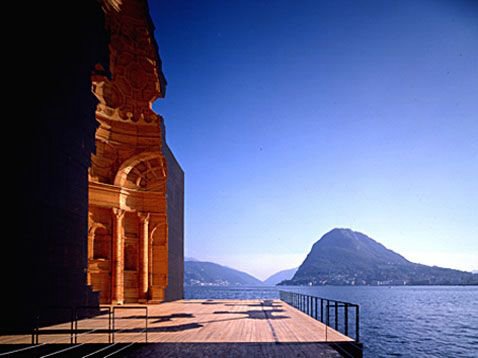
In 1999, Swiss architect Mario Botta was commissioned to design a model of Francesco Borromini’s Church of San Carlo alle Quattro Fontane, in Rome.
Called San Carlino, Botta's model – part building, part sculpture – was erected near Borromini's own birthplace, on the shores of Lake Lugano, to celebrate the 400th anniversary of Borromini's birth.
Botta's work was dismantled in 2003.
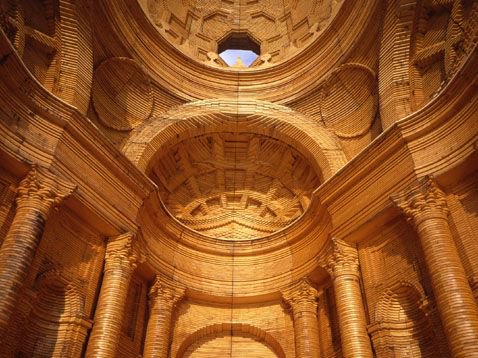
The project was made using 35,000 wood boards, each of which was cut, milled, and sanded, then assembled with the rest to reproduce the exact internal volume of Borromini's church.
Well, half of Borromini's church.

The interior, in other words, was carved out of this colossus of wood; the space of the church was milled, excavated from the stacked material.
This virtual walk-through gives a nice, if badly lit, sense of the abrupt edge Botta designed for the model –

– because as you can see from Botta's own sketch, below, he effectively cut the church in half; measured the internal volume down to the scale of centimeters; then reproduced that void using 35,000 specially cut boards.

Certain photographs I've seen are actually quite astonishing; the freshly cut boards in the earliest photographs all but glow compared to the coal-black exterior, and the blue skies of Lugano add a surreal backdrop to the unexpected sight of the semi-sacred hollow.
I have to admit, however, that when I first saw those photographs I did not understand what I was looking at. My first reaction was fairly predictable, I suppose, and that was to picture a huge milling-machine, built to the exact volume and measurements of Borromini's church – a kind of void-grinder several stories high, whirring with precise blades and abraders, like some massive (perhaps consecrated) mining machine.
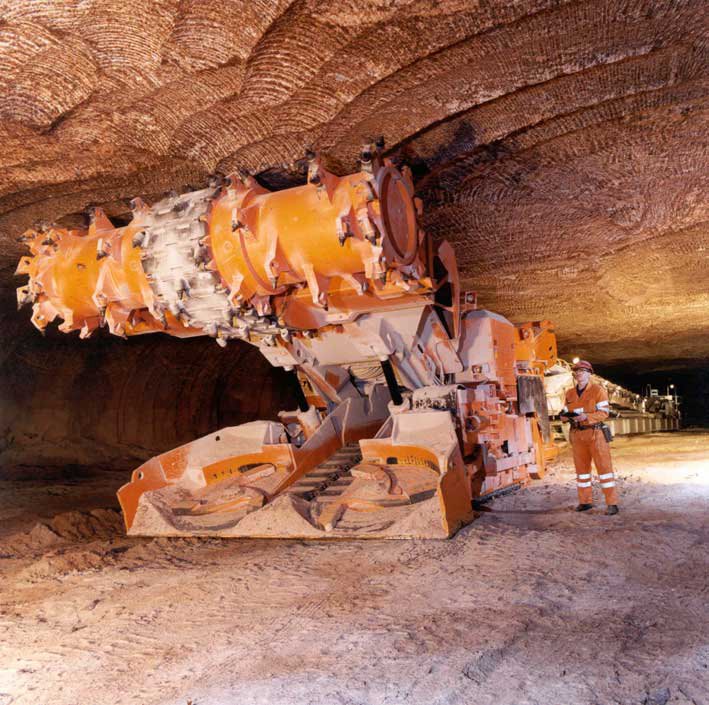
That would, of course, be ridiculous; but it got me thinking.
I wondered if you could precisely measure the interior space of Notre-Dame, for instance, then build a grinding machine to those specifications. A kind of inside-out abrader. A void-grinder. You could then park that thing in front of a mountain and lo!
Three hours later the exact internal dimensions of Notre-Dame – the hollows and side-chapels, the soaring interior of cross-vaults – have been carved, in real size, into the granite surface of the Teton Range.
You can walk into that hollow, light a candle, and be damned if it doesn't look exactly like the real thing...
You could do this for any cathedral on the planet. Measure its exact interior volume, using lasers perhaps, and then use those measurements to fabricate a grinding-machine.
Then choose your target: the interior of Chartres, for instance, could be carved into the quartz-belted strata of the Canadian Rockies. The interior of St. Paul's whirred and abraded into the mountains of Bamiyan, where the Buddhas once stood.
You could even map out, to the millimeter, the internal volume of every cathedral, mosque, and temple in the world, and then program that into a robotic rock-milling machine. You then send that machine to the moon where, over the course of two generations, it carves the exact, to-scale internal voids of beautiful sacred architecture into the lunar surface.
From the earth it looks as if small caves are appearing on the moon, like sink-holes or new craters – but you take out your telescope, go into the backyard with your friends, and look up: there, hollowed out, void-black on the moon are hollow reproductions of Chartres Cathedral, Salisbury, Hagia Sophia, Angkor Wat.
Future lunar expeditions go torchlit through those caves, re-breathing tanked oxygen: what were these things...?
from bldgblog
標籤:
architecture,
sculpture

订阅:
博文 (Atom)