显示标签为“image”的博文。显示所有博文

1.09.2009

Deserted

[Image: Photo by Benoit Aquin for Walrus Magazine].

I came across an article just today called "The Chinese Dust Bowl," published last October in Canada's Walrus Magazine (a great magazine – don't miss their look at New York City flood barriers).
The accompanying photographs of dust storms, ruined crops, dead forests, and hazed-over city squares, taken by Benoit Aquin, are really fantastic – and you can look at a complete PDF of the article here.
For the article, author Patrick Alleyn rode something called the K43-T69 train west from Beijing to explore the seemingly relentless process of Chinese desertification. "A few hours after the train leaves Beijing," he writes, "a lunar black mountain range welcomes passengers into a vast arid landscape."

[Image: Photo by Benoit Aquin for Walrus Magazine].

This is what Alleyn refers to as "the Chinese Dust Bowl" – "a dreamscape of steppes and deserts" – which is "probably the largest conversion of productive land into sand anywhere in the world."
    To date, Chinese farmers and herders have transformed about 400,000 square kilometres of cropland and verdant prairie into new deserts. The shepherds have overgrazed the steppes, allowing their sheep and goats to chew the grass all the way down to its roots. The farmers, for their part, have over-exploited the arable land by opening fragile grasslands to cultivation and over-pumping rivers and aquifers in the oases bordering the ancient deserts. The area of desert thus created is equivalent to more than half the farmland in Canada.
Alleyn mentions the Great Green Wall – a massive reforestation project intended to stop the spread of the desert (but that has had a ruinous effect on local groundwater supplies) – and the epic South-to-North Water Transfer, among other things; but the PDF is worth checking out in full, especially for Aquin's photography.

Pandemonium

[Image: From "City of Shadows" by Alexey Titarenko].

Some of the coolest photographs I've seen recently are these long exposure shots of crowds in St. Petersburg, Russia. They were taken by Alexey Titarenko for a project called "City of Shadows."
What I think is so interesting about this is that an otherwise unremarkable technique – the long exposure – has the effect of transforming these assemblies of people into demonic blurs, black masses moving through the city. These look more like scenes from Jacob's Ladder or Silent Hill.
In the photograph below, for instance, the repeating glimpse of a hand pulling itself up the banister seems strangely unnerving –

[Image: From "City of Shadows" by Alexey Titarenko].

– and, in the next photo, the crowd takes on the appearance of a machine, hauling itself through human gears up the stairs of old buildings. A mechanism of bones from the afterlife.

[Image: From "City of Shadows" by Alexey Titarenko].

But I suppose this is what the world would look like if we could see the residue of everyone who's ever passed through – a vast, multi-limbed creature made of tens of thousands of human bodies, winding its way through streets and buildings, looking for some place to go.
See more from this project and others at Alexey Titarenko's website.

(Thanks to Adam Billyeald for the tip!)

1.04.2009

High-Rise

[Image: Tower demolition in Philadelphia, as photographed by werdsnave. Perhaps that room at the very top could be rehabbed and kitted out with a small suburban house... or some version of this thing... making it worth the climb. Elsewhere: A tunneling project by werdsnave on Pruned. Earlier: Chicago's Inner Flute-Ruins].

from bldgblog

Climbing Mt. Improbable

[Image: Matthew Putney, for the LA Times].

On the front page of the LA Times today, greeting the new year, is a story about a man with a plan in Iowa: "Surrounded by cornfields that stretch to the horizon," we read, "in a place where molehills pass for mesas, avid outdoorsman Don Briggs has long dreamed of climbing a mountain. So he decided to build one."

[Image: Matthew Putney, for the LA Times].

He's not a geotechnical engineer, or some wildly charismatic salesman of earth-moving equipment; he's just a man with a water hose and access to a few corn silos.
"Briggs spends most winter nights hosing down a quartet of grain silos on a friend's farm – and relies on the Corn Belt's frigid temperatures to transform the water into frozen walls of ice that tower nearly 70 feet straight up," the LA Times writes.
"By the time he's done, the ice encasing the outside of the silos is 4 feet thick in spots – and ready for the onslaught of ice climbers drawn to this strange marriage of farming and extreme sports."

[Image: There would sometimes be "a heat wave," Don Briggs told the LA Times, "when the temperature got up to 40 degrees or warmer, and all the ice would fall off the silos and we'd have to start all over." Photo by Matthew Putney, for the LA Times].

The transformation of architectural structures into geological objects is something worth pursuing; in a way, it reminds me of a fairly minor pet peeve of mine, which is that people like Colin Farrell, or Lindsay Lohan, come out to Hollywood or move to Manhattan, and they make tens of millions of dollars... and they buy liquor with it. Or crystal meth and expensive dresses. Or whatever it is that River Phoenix did.
But when was the last time you heard about some hot young actor pocketing $20 million to star in a new Tony Scott film – then promptly disappearing into the plains of Iowa where he (or she) contracts out the multi-million dollar construction of a new mountain chain? Complete with manmade glacier?
Rather than buy Escalades, diamonds, and a few bottles of Courvoisier, in other words, why not compulsively build whole transparent cities of plexiglass, uninhabited in the mountains of central Idaho?
If you're going to get addicted to something, make your addiction interesting.
Rather than donate all his money to Scientology, Tom Cruise funds the excavation of a spectacular series of show-caves, curling under the soil of Wisconsin. He sinks millions and millions of dollars into it, and dances on the couches of primetime news shows to sing the praises of subterranean topography.
Which is nothing compared to Robert Downey Jr., who is now rumored to have addicted himself to producing large-scale earthworks, made of polished obsidian, in eastern Washington state... He takes jobs in Uwe Boll films just to buy more rock...

(Thanks to N for the ice silo link!)

from bldgblog

Energy plants

energyplantposter_t346

[Image: Metropolis points us toward a new design project by Aleksandar Rodic. "Windfarm installation is controversial in many communities," Metropolis writes. The controversy is relatively superficial, however, as it's inspired by worry over "the visual impact of turbines... on the natural landscape." Thus, to improve "the aesthetics of renewable power generation," there is REimaginations, a traveling exhibit in which Rodic's image first appeared: "Compared to polluting energy sources, the exhibit suggests, 21st century wind farms represent an elegant blend of form and function." For a related project, see WorldChanging].

from bldgblog

Filaments of space-time


[Images: Density plots of matter in space – whorled lattices of knots and self-intersection – from the Max Planck Institute for Astrophysics].

At the University of Durham, UK, there's a group of scientists and computer programmers who call themselves the Virgo Consortium for Cosmological Supercomputer Simulations – a name which leads me to wonder who is cosmologically simulating a supercomputer, and why.
But the purpose of the Virgo Consortium is to use "cosmological simulations" to study "the large-scale distribution of dark matter, the formation of dark matter haloes, the formation and evolution of galaxies and clusters, the physics of the intergalactic medium and the properties of the intracluster gas."
So what's this got to do with BLDGBLOG...?
Some comments at the end of a recent post made me think of images I've seen of intergalactic structure – what the universe looks like: webs of stars in space, huge arc-bubbles of light colliding with themselves in glowing, superskeletal networks, filling space like translucent caulk.
But when I went to find those images again I realized you can actually watch entire films, simulated fly-throughs, of the quantum void, passing through vaults of gravitational foam, and those interstitial spaces seemed perfect for a quick new post.


[Image: "Surrounding and stretching between galaxies, there is a rarified gas that is thought to posses a cosmic filamentary structure... This material is called the intergalactic medium (IGM) and is mostly ionized hydrogen (i.e. a plasma)." These images show "the formation of a galaxy cluster." Structure, it seems, is really a compression or tightening – a focusing – of the surrounding medium. From Craig Booth/The Virgo Consortium].

So the Virgo Consortium, which I've mentioned, is a partner of the Max Planck Institute for Astrophysics, and among its tools are a Cosmology Machine and a Sun Grid Engine, both of which surely sound like something straight out of the novels of China Miéville.
Some of the images and simulations these institutes produce, however, are so intensely beautiful that simulations of the universe could perhaps be seen as something of a niche market for starving artists, a new genre of self-expression. Rather than writing novels – you simulate the cosmos. Over and over.


[Images: From the Millennium Simulation; time advances as you go down till "structures are abundant in the universe manifesting themselves as stars, galaxies and clusters." (Images by the Virgo Consortium)].

So the following short films either take you flying through the universe for all too brief an instant, or they show structure crystallizing out of the universal void-plasma. Either way, enjoy: film 1; film 2 (which seems to portray the universe as a kind of malfunctioning television set); film 3; film 4; and – I like this one – film 5, a kind of slow, hypnotic, black-and-white cosmology as filmed by Jean Cocteau.


[Image: Cosmic filamentary structure – buttresses of light – foregrounded against gravitational darkness: Max Planck Institute].


[Image: A Warholian depiction of the universe: Max Planck Institute].

from bldgblog

1.03.2009

Return of the architecturally averaged image

The unflappable Meggan Gould has apparently been producing loads of these things – art gallery owners, heads up – averaging the first 100 images that respond to a Google Images search (though one wonders what photo-ontological nightmare will arise when Gould's own photographs begin appearing in the tally...).
So here are a few more (received at the BLDGBLOG offices via email this past weekend) – the world's architecturally averaged imaginary:


[Image: parthenon].


[Image: big+ben].


[Image: taj+mahal].


[Image: world+trade+center].


[Image: washington+monument].


[Image: delicate+arch (Utah) – not exactly architecture, but...].


[Image: stone+henge].

And there are many, many more where those came from. Meanwhile, Jason Salavon's work on the averaged-out US housing market continues to astound; and Ms. Gould is even now busy producing new work...
(How about arch+of+constantine? crop+circles? mount+everest? old+faithful...?)
hollywood+sign...
neverland+ranch...
cenotaph+for+newton...


New maps of national absence

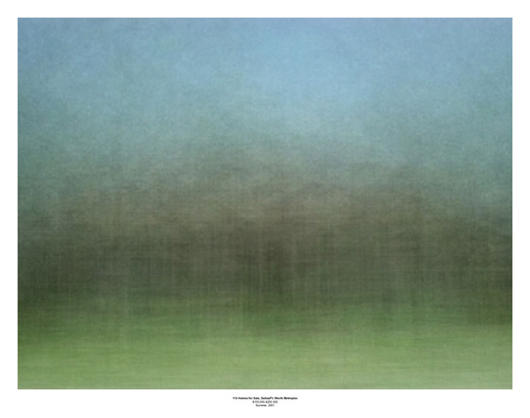
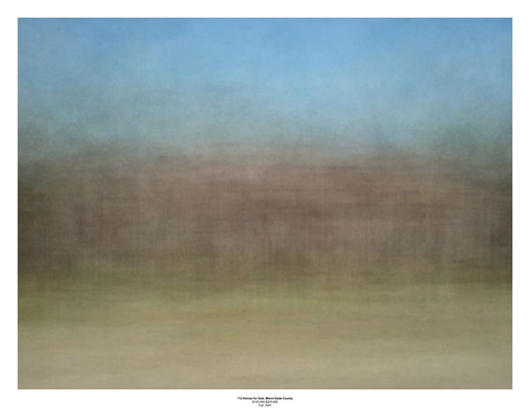
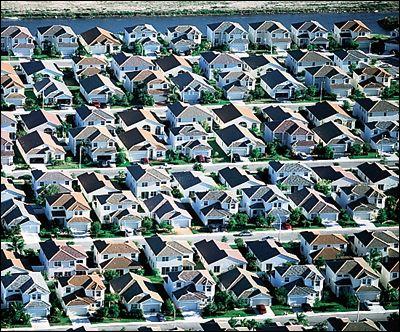
As per the architectural averages of Meggan Gould, Jason Salavon, self-styled photographic king of the averaged image, has declared war on the US housing market through a really almost awe-inspiring photographic series called "Homes for Sale."
By taking the visual average of, for instance, 114 homes for sale in the Dallas/Ft. Worth area –


[Image: 114 Homes for Sale, Dallas/Ft. Worth Metroplex].

– Salavon really just obliterates any claim to individuality – let alone architectural interest – that the (literally) average American home now has.
The housing market, in other words, has broken.


[Image: 124 Homes for Sale, The 5 Boroughs].


[Image: 117 Homes for Sale, Chicagoland].

How do you even know where you are? New York? Chicago?
St. Louis?
What's so exciting about these images is how sarcastically condemnatory, rigorously critical, and yet strangely beautiful they really are. Of course the promising landscape of "America" is being destroyed by its own architecture; of course that country is falling victim to bad – or utterly absent – planning.
But Salavon's images make this visually obvious, graphically accessible; they take what every American sees, everyday – driving through the exurbs, living in the midst of the homogeneous – and these images give it an iconography.
They represent the total mediocrity of America's anarchitectural establishment.
Everyone's houses look the same.


[Image: 121 Homes for Sale, LA/Orange County].


[Image: 112 Homes for Sale, Miami-Dade County].

Do you live in LA, or do you live in Miami? How the fuck can you even tell?
The symmetry and abstraction is by now so complete that America could fold in on itself through some complicated topological procedure, coast to coast, heartland to homeland, LA to Miami... and it could utterly disappear.


[Image: 109 Homes for Sale, Seattle/Tacoma].

Toward the end of Mark Rothko's life, as he drifted closer and closer to an unavoidable suicide, the paintings he produced grew more and more monochrome, lunar, enveloped in black and white, monumental, voidlike, immense.


[Image: Mark Rothko, Untitled, 1969].

As the color and vibrancy and detail and expressive individualism – even the ironic beauty – of the American housing market continues to flatline, it will be interesting to see if, in several years' time, as the decades turn, as the millennium ages, perhaps Jason Salavon can return to this series and produce more maps of the architectural void, the evening-out, the swan song, the facade of national absence, to see if the architecture of an entire nation has succeeded in committing suicide.


[Image: Mark Rothko, Untitled (No. 4), 1964].

Until then, millions and millions of American homes will continue to be for sale.


(Via, and with thanks to, Abe Burmeister at Abstract Dynamics).


Architectural averages

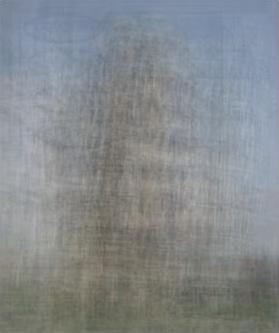
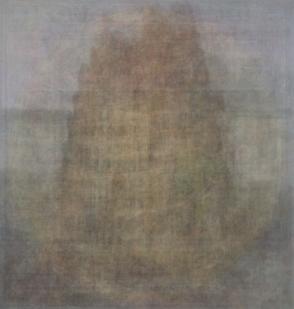
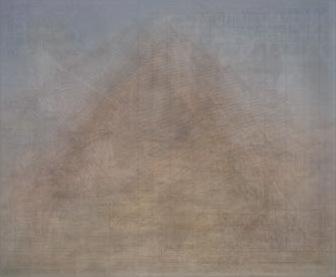
The series Go Ogle by photographer Meggan Gould takes the first 100 responses to a Google image search, then overlays those 100 images into a single photographic "average."


[Image: leaning+tower+pisa].

As Gould herself writes:
"The results, a visualization of intersections between Boolean logic and the popular imagination, are more often than not a hopeless jumble of unidentifiable pixels – but occasionally a recognizable form does emerge." See animation.
"Word choice, spelling, and textual hints are all critical to conducting an effective search, and the averages reflect their importance: a search for coke+can reveals a crisp, almost legible average, whereas coca+cola+can is muddy and barely recognizable. Truly iconic imagery is elusive, particularly considering the glut of computer graphics through which internet spiders and archivers crawl daily; only a small fraction of searches retains any degree of legibility through the averaging process."
But some of the most recognizable averages, I have found, are architectural.


[Image: tower+babel].


[Image: pyramid+giza].

Leaving me to wonder what has to be at least one other BLDGBLOG reader's first thought: what about world+trade+center?
september+11th?
If BLDGBLOG was richer, in fact, it could probably keep Meggan Gould in business for several years, producing more and more – and more and more – architectural averages: stone+henge; san+andreas+fault; berlin+wall; yucca+mountain; space+shuttle; taj+mahal; falling+water...

PS: big+ben; forbidden+city; chrysler+building; trump+tower...


from bldgblog

Lime Works / Mineral Futures / Surface Excavations


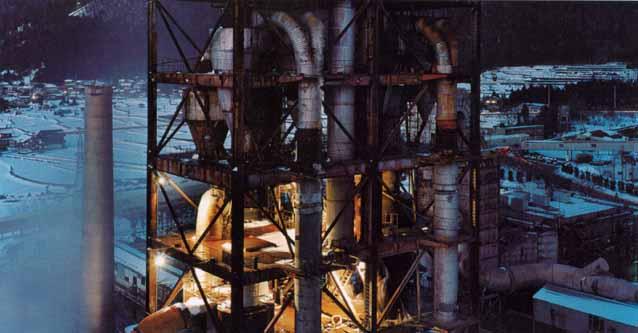
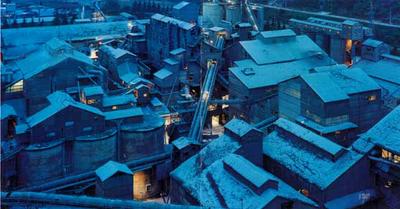
Though the work of Naoya Hatakeyama has just been explored elsewhere, these photographs – entitled Lime Works (Factory Series) (1991-94) – totally blow me away.
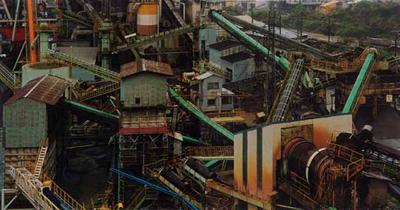

For starters, their extraordinary density almost imitates the stratigraphy of the rocks being scraped through –
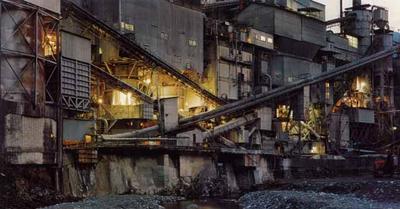

– even while they document how an increasingly powerful part of the human population interacts with the earth's surface: through highly technical, and very large, digging machines. Entire architectural complexes, instant cities, lit from within and steaming.
They document, in other words, the human interaction with geology.
Here, of course, that interaction takes the form of an excavation complex crossed by elevated walkways – and it looks like something straight out of Star Wars –
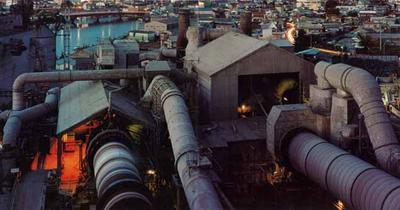

– or a kind of mineralized King Arthur, ruling from behind a Camelot of mines...
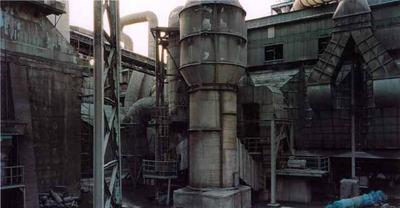

But these photos also bring up the global market in rocks – or the financialization of geology through mineral futures, where taxed and quantifiable fragments of the earth's surface can be traded as commodities on the futures market.
Lime, after all, is a very useful mineral, with entire international associations and Mineral Information Institute reports devoted to its scientific study, value, and market exploitation.
As that latter link informs us, in fact, "Lime has been used for thousands of years for construction. Archeological discoveries in Turkey indicate lime was used as a mortar as far back as 7,000 years ago. Ancient Egyptian civilization used lime to make plaster and mortar."
Meaning, of course, that these photographs show us an architecture of machinery busy digging up a mineral – that will be used by more machinery in the construction of future architecture. (That, in many ways, is the closed loop of the extraction industries: a campsite digging for oil – because its drills need more oil... At some point the whole thing becomes not unlike performance art.)
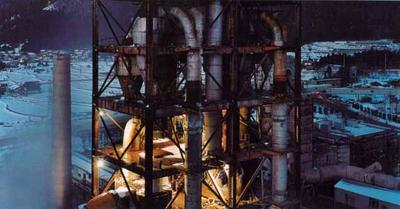

[Image: A lime works excavation tower seen against the landscape it will soon absorb. If the earth could make horror movies, one wonders if this would be the opening scene...]

I'm left with speculation:
If human beings actually do survive the next ten thousand years; if all this excavation not only continues but accelerates; if usable mineral deposits continue to be found, but only deeper and deeper beneath the earth's surface; then perhaps we might find that we've stripmined every continent below the waterline, returning the earth to the early Devonian, when warm, shallow seas covered most of the planet – only now, or then, the earth will be shelled by a new global city of interlocking excavation architectures – gantry cities, derrick towns, Constant's Babylon –
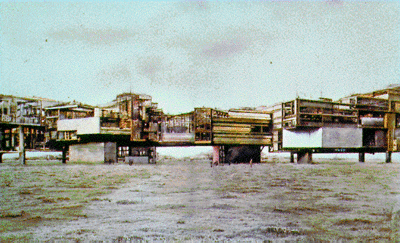

– complete with feudal rock-salt guilds and a new U.N. of floating lime works factories.
But deep below, in the dark webbing of undersea buttresses, where barrel vaults are covered with scabs of bleached coral, future geologists will be found scuba diving, like Steve Zissou, seeking out new metals and mineral deposits, torch in hand, scouring the outer edge of a flooded earth, diving further and further toward the core.
Then, one day, the digging machines simply put themselves out of business – because the planet has disappeared.

from bldgblog

The Monitor Mine

As old computer monitors – and harddrives, and printers, and scanners, and modems – continue to pile up in the cities and villages of the 3rd world, we're faced with a kind of mass geological displacement, or literal new mountain ranges of obsolete technology: all those minerals, the circuits and wires, forming new mines left open on the earth, leaching into groundwater, infiltrating bodies, forming cancers, going to waste.
A kind of monitor mine.

[Image: The Basel Action Network/New York Times].

In Perdido Street Station, by China Miéville, our erstwhile hero finds himself hiding out for some reason in a huge scrapyard full of refrigerators and harddrives and household waste and home appliances, and – yes – the whole thing just wakes up, anatomically rearranges itself – and mobilizes, artificially intelligent.
As if this could suggest that one day we might find deserts all over the world – their huge, moving dunes of loose silicon, in strange magnetic union with belts of metal in the earth's surface – have somehow programmed themselves, a planetary harddrive communicating through landfills overflowing with old computers, discarded wireless modems, mountains of digital rubbish piled in rings around African villages.
And it's not landscape tectonics but a new form of life...
(Perhaps a novel coming soon – from BLDGBLOG).

from BLDGBLOG

The residual landscape (China)

I've already posted two photographs by Edward Burtynsky (see "Naxos Quarries"), but I went clicking back through his site last night and decided to add some more, this time expanding BLDGBLOG's ongoing exploration of space in China.
Here, then, are photographs of factories, from Burtynsky's Manufacturing series, and they're so strikingly self-similar and excessively color-coded they look like IKEA assembly plants, not factories at all.
Take a look:


[Images: From top to bottom: "Manufacturing #18, Cankun Factory, Zhangzhou, Fujian Province" (2005); "Manufacturing #16, Bird Mobile, Ningbo, Zhejiang Province" (2005); "Manufacturing #17,Deda Chicken Processing Plant, Dehui City, Jilin Province" (2005); and "Manufacturing #11, Youngor Textiles, Ningbo, Zhejiang Province" (2005) – and substantially larger versions are available if you click on them].

Burtynsky uses photography to explore what he calls "the residual landscape," or the geo-cultural margins of "the great ages of man; from stone, to minerals, oil, transportation, silicon, and so on."
And some of his images are so stunning I might post a few more soon...