显示标签为“all sur the light and la lumière”的博文。显示所有博文

3.02.2009

星光侦探——天体分光术的诞生

Melipal 发表

Alan W. Hirshfeld,编译自Sky& Telescope, Vol. 108, No. 2 (2004)

通过分析星光,天文学家打开了一扇通往天体物理学这一崭新研究领域的大门。

当工业时代进入高潮的时候,尚处幼年期的天体摄影术也一样。全球各地的天文学家迅速认识到了摄影与望远镜联合工作的强大能力及其能为人们带来的科学 收益。19世纪中叶,他们已经获得了月球、太阳和恒星的照片。但尽管照片能使人们对天体进行空前的分析,它们却只讲出了故事的一部分。恒星的化学和物理性 质仍旧是个谜题。法国哲学家奥古斯特·孔德(Auguste Comte)曾经咬定,由于恒星和星云过于遥远,它们将永远埋藏自身化学组成的秘密。那么我们能不能对遥远的恒星和星云在“实验室中”进行详尽审查呢?

自17世纪起,太阳的光谱就不断地被科学家研究了。这些研究者中包括艾萨克·牛顿(Isaac Newton),他将一窄束阳光引入一间暗室中,并用玻璃三棱镜将其分解。但是直到两个世纪之后,罗伯特·本生(Robert Bunsen)和古斯塔夫·基尔霍夫(Gustav Kirchhoff)才说明,每束阳光是如何将太阳的化学组成显露出来的。如果说太阳彩虹中的特征线是埃及圣书文字,那么本生和基尔霍夫1860年的论文 《由光谱观测进行化学分析》就可以称作天文学家的罗塞塔石碑。

光谱ABC

天体分光术的首个重大突破出现在1802年,当时英国化学家威廉·海德·渥拉斯顿(William Hyde Wollaston)观测到了太阳连续光谱背景上的几道暗线。渥拉斯顿错误地认为它们是不同颜色之间的天然界限。10年后,光学大师约瑟夫·夫琅禾费 (Joseph Fraunhofer)在检验几片自制透镜的质量时,用一架小望远镜放大了太阳光谱,并数出了574条暗线。他将其中最突出的一条标注为A,后面是B、 C、D,依此类推——这些名称沿用至今。夫琅禾费注意到,D线(实际上是一对距离很近的双线)的位置看起来与蜡烛火焰中的明亮黄线相同。他不知道这种一致 是否有意义,也不能解释太阳和实验室对应光源光谱中暗线的成因。

上图:约瑟夫·夫琅禾费(1787-1826)出身贫寒,几乎没有接受过正规教育,但却成了熟练的仪器制造者,也是一位天文学的先驱。他对太阳与其他天体的光谱研究在当时是空前的。(图片提供:俄克拉荷马大学图书馆科学史收藏)

后来,夫琅禾费将注意力集中到太阳以外的其他天体上。他使用一架配备有三棱镜的4英寸折射镜观察了月球、几颗行星以及明亮恒星(包括天狼星和北河 二)的光谱。他发现,在太阳、行星以及不同恒星的光谱中,比较明显的暗线位置往往是不同的。这时,夫琅禾费回到了他制造望远镜的日常工作中去,而天体分光 术这一崭新的领域也沉睡了40年。

夫琅禾费之后,全欧洲的化学家研究了不同火焰以及电弧的光谱。实验数据积累下来了,分光学的理论也变得丰富了。甚至有线索表明,每种化学元素或成分 都能产生自己独一无二的谱线,因此通过分光术分析物质——哪怕是鉴别新的元素——也是可行的。在众人高高的期望中,那条曾令夫琅禾费迷惑的D线是个“套环 ”,它使第一条解释陷入窘境;黄线就好象是个不速之客,几乎出现在每种物质的光谱中。为什么元素的光谱(如果假设各元素谱线是独一无二的话)都有同样的一 条线?最终,两名德国科学家解答了这一问题。

约瑟夫·夫琅禾费让明亮的阳光穿过分光仪(上图),从太阳光谱中分辨出了多条暗线,并 将它们用字母标示出来。下面这张原始光谱图由夫琅禾费本人手工上色,清楚地标出了每条暗线的位置。他的“D”线,也就是日后认定与钠元素有关的双线,是认 识光谱成因的关键。(图片提供:慕尼黑Deutsches博物馆)

分光术先驱

罗伯特·W·本生在实验室中大胆无畏,甚至在1843年那次化学药品爆炸导致右眼失明后仍旧如此。他照常去研究有毒物质,譬如气味“能让手脚瞬间刺 痛,甚至是眼花无知觉”的砒霜。不过,本生成了德国最重要的分析化学家。他的古怪是颇有传奇色彩的。据他的一个学生观察说,本生的“耐火能力非常强,他可 以拿起热试管,还经常将手指在吹管口,这时我闻到了燃着的本生,而他的指头也冒烟了!”

上图:分光术的两位先驱者,罗伯特·本生(1811-1899,右)及古斯塔夫·基尔霍夫(1824-1887)研制了那个时代最灵敏的分光计,并引起了分光学这一领域的变革。他们证实夫琅禾费D线是由钠元素引起的,并发现了铯和铷,还最先解释了发射线和吸收线的产生机理。(图片提供:E. F. Smith Collection,宾夕法尼亚大学图书馆)

在做过的无数实验中,本生试图通过观察在与他同名的灯中燃烧的物质发出的彩色光芒来鉴定其组分。他的同事兼好友、物理学家古斯塔夫·基尔霍夫建议他使用三棱镜去观察每种燃着物质的光谱。他们一起研制了高精度分光计。

e

上图:本生和基尔霍夫的分光计(图片来源:J. N. Lockyer, Solar Physics, 1874)

本生和基尔霍夫使用他们的新设备解决了D线无处不在的疑难——今天我们知道,D线是钠元素存在的踪迹。他们意识到,困扰前辈的是实验室中一种不曾料 到的污染物:食盐!氯化钠,也就是食盐,在地球表面处处有分布,而如果不加留心的话,它就会渗进化学样品中。正如19世纪的历史学家艾格尼丝·M·克拉克 (Agnes M. Clerke)所描述的那样,“(食盐)在空气中漂浮;在水中漂流;每粒尘埃中都有它的粒子相随;排除它绝对是不可能的”。

D线问题的解决不仅是本生高超实验技术的反映,更是光谱分析学超高灵敏度和科学潜力的体现。似乎是要强调后者的威力,本生和基尔霍夫凭借他们的强大工具,仅仅依靠观察光谱就发现了两种新元素:铯和铷。

之后海德堡的两位科学家证实,在实验室光谱中观察到的亮线序列与太阳光谱中的暗线序列精确吻合。因而夫琅禾费的暗D线说明,太阳上有钠元素,其他夫琅禾费线也就表示其他化学元素的存在,其中包括太阳最丰富的组成元素——氢。

他们破天荒的实验也告诉物理学家不同类型光谱的基本成因:稀薄气体的光谱可以是实验室中所见的发射谱,也可以是太阳光谱暗线那样,是在白热背景上的吸收线。

本生和基尔霍夫的实验衍生出了大量意义深远的结果。一次两位科学家将他们的分光计对准窗外10哩以外一团烈火的化学成分。本生想,如果他们可以确定地球上火焰的组成,某日天文学家能否对着群星做出同样的事呢?

上图:光谱有3种表现形式:连续谱、吸收谱和发射 谱。白色光源发出的光涵盖了整个可见光波段;而其所得的光谱就是经典的彩虹图样。吸收线的产生是由于在光源前方有一团吸收介质(如冷的气体)遮挡,吸收了 某些特定波长的光线。其结果就是在光谱中出现了间隙。热的稀薄气体能产生发射线。(图片来源:Astronomy Today)

本文来自科学松鼠会http://songshuhui.net

2.26.2009

Ruairi Glynn

VIDA 11.0 Art and Artifical Life

February 23rd, 2009

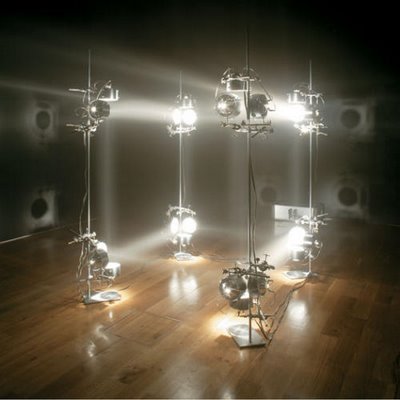
I have recently come back from Madrid where I was exhibiting my piece Performative Ecologies at VIDA 11.0 alongside some great installations from Philip Beesley & Rob Gorbet, Chico MacMurtie, Jed Berk, Chris Sugrue and Damian Stewart. With the kind help of my brother Ronan, we have made a small film of the exhibition which you can see above. Regine on wmmna has more detailed coverage of the exhibition.

Interactive Architecture has been quiet for the past 6 months mainly due to taking on a new teaching position at the Bartlett School of Architecture’s Adaptive Architecture and Computation Masters. More about this in the near future but for now all I’ll say is that my plan is to get blogging back into my weekly routine so if anyone has any interesting suggestions for new articles please let me know.

Entry Filed under: Bartlett, Interactive, Kinetic, Lighting, Scuplture/Installation

via interactivearchitecture

1.09.2009

White Light

[Image: White Noise/White Light, Athens, by Höweler + Yoon/MY Studio].

I stumbled on an old project from the summer of 2004 today, by Höweler + Yoon/MY Studio, called White Noise/White Light.
The project was on display in Athens during the 2004 Olympics:
    Comprised of a 50' x 50' grid of fiber optics and speakers, "White Noise/White Light" is an interactive sound and light field that responds to the movement of people as they walk through it... As pedestrians enter into the fiber optic field their presence and movement are traced by each stalk unit, transmitting white light from LEDs and white noise from speakers below.
And though I wasn't in Athens to see the thing in person, it certainly did photograph well.

[Image: White Noise/White Light, Athens, by Höweler + Yoon/MY Studio].

Juxtaposed with the Parthenon in the background, the effect, in fact, looks quite mesmerizing.
Electrical practicalities and issues of light pollution aside, it'd be nice to install something like this for a few nights along the rim of the entire Grand Canyon... Then fly over it in a glider, at 3am, taking photographs.

UPDATE: How strange: I came home from work today to find two copies of Architect magazine waiting for me in the doorway – and lo! On p. 49 of their September 2007 issue there's nothing else but "White Noise/White Light" by Höweler + Yoon... Architect says: "The experience and publicity that Höweler + Yoon gained from the Olympics project have led to new commissions and further explorations in up-to-the-nanosecond lighting technologies." Interesting overlap.

(Earlier: Archidose blogged it).

Spies, Light-Writing, and the Surface of the City

[Image: By and via Energie in Motion].

This morning's post reminded me of a link someone sent in two weeks ago: Energie in Motion, a light-writing project by two guys in Germany.
Hey, little man! What are you doing outside by yourself? You look sad.

[Image: By and via Energie in Motion].

There's no need to hide!

[Image: By and via Energie in Motion].

It's just me...
For more images, stop by the Energie in Motion site itself. There's even a short video you can watch of the men at work, writing with light in Munich and Hamburg, turning parking meters into robots and animating street signs with little glowing arms and legs.
It'd be interesting, meanwhile, if you could install some sort of moving light sculpture in the center of the city. The sculpture appears to be totally abstract: casually and randomly, it switches back and forth amongst various positions, spinning little lights around, making arcs, circles, hops, jumps, and flashes, all to no real purpose or design – but then someone accidentally takes a photo of it using too long an exposure...
The resulting images, developed back at home in a basement darkoom, reveal that the sculpture is actually writing things in space.
Like this:

[Image: By and via Energie in Motion].

It just requires an elongated present moment in which to read it.
Turns out it's a new way for spies to communicate – and this random tourist with a camera has now uncovered a sinister plot...
Alfred Hitchcock directs the film version.

(Thanks, Joel D.! Vaguely related: Automotive Ossuary).

1.04.2009

Color Shift

Ben Aranda and Chris Lasch, of terraswarm, creators of the infamous 10 Mile Spiral as well as the Brooklyn Pigeon Project, will be unveiling a new project on Monday night in Manhattan.
Called Color Shift, the installation "is an urban-scaled art project made by inputting a continuous stream of alternating colors into the FreshDirect video billboard, the largest in the country." As such, it's a kind of creative mis-direction of urban light pollution – a post-Duchampian optical relief in technicolor, throbbing through a dozen spectra across the roofs and walls of New York City.

You can watch a virtual version of Color Shift, installed online – it's a weird, hypnotic abyss of slow alteration that, at one point, made my eyes feel broken. Very Olafur Eliasson-esque.
Ben and Chris will be speaking Monday night, March 19th, at 6:30pm in Columbia University's Wood Auditorium, Avery Hall. Tell them BLDGBLOG sent you.

from bldgblog

A cubic meter of fogged space


[Image: 1M3 Light, 1999, by Olafur Eliasson, described by Metropolis as "a cubic meter of fogged space." From the article: "Using light as others might use bricks and mortar, Eliasson turns luminosity into an architectural element. Often water is the facilitator. He partitions space with curtains made of drops of water frozen by strobe lights... or he converts fog into a building material, neatly carving a cubic meter of emptiness by slicing through a foggy room with spotlights." Photo by Jens Ziehe].

(Earlier: More Eliasson at Four-dimensional films).

from bldgblog