BBC 中文网 | 时事专题 | Pundit Commentary | 中国农村地区生态环境状况令人担忧:
"中国农村地区生态环境继续恶化,主要表现在:
第一:城市的工业污染急剧向农村扩散;
第二:农业生产所使用的化肥、杀虫剂等对于土地和水体的污染依然持续;
第三:农村饮用水存在安全隐患,3亿多农村居民没有安全清洁的饮用水;
第四:自然生态继续恶化,沙漠化、次沙漠化、水土流失、湿地消失的趋势未能得到控制。
最近几年以来,有大量的污染企业或者是会产生大量的污染的产品从城市向农村转移。由于城居民的生态环保意识得到加强,迫使许多污染企业在不改造的前提下无法在城市继续生存下去。中国政府也在实际措施中鼓励污染企业从人口密集的城市向人口稀疏的农村转移。比如北京为了举办奥运会,将北京城中的污染企业迁到邻近的省区。因此各省区也纷纷仿效北京的做法,把污染企业从省会城市向农村转移。
在二十世纪的七、八十年代,工业发达国家也曾经把污染企业从城市转移到农村地区,期望能以此解决环境污染问题。但是不久他们就发现,这样做的后果不是减小了污染,而是扩大了污染,最终结果是不利于治理污染。因为农村地区人口较少,所能施加的政治压力也小。之后他们就放弃了这种做法(但是没有放弃把污染企业向发展中国家转移),而是坚持在当地进行改造,减少污染的排放。而中国目前则是继续工业发达国家曾经犯过的错误。在中国这种做法的危害更大。在西方社会中,农村人口的文化素质和环保意识和城里人没有区别,而在中国,农村人口的文化水平低,对环境污染危害的认识也比不上城里人。况且他们大部份人又不享受医疗保险,一旦遭到污染危及健康,后果十分严重。
业绩下的牺牲者
在中国,农村地区的党政官员为了创造业绩,牺牲当地农民的利益,积极引进污染企业,目的只有一个,提高县镇的GDP的发展速度,为自己的升官晋级提供敲门砖。他们最常用的说法就是,环境保护不能阻碍经济发展,环境保护不能妨碍发财致富。
最近暴露出来的云南省阳宗海水体污染事件,就是一个污染向农村转移的典型例子。造成这次水体污染的是云南澄江锦业工贸有限公司的一个化工厂,这是一个私有化了的镇办企业。他们生产的就是从城市向农村转移的有污染的化工产品。生产这种产品GDP高,所以是当地政府保护的'大企业'。该产品在生产过程中会产生大量含砷的废水。砷就是老百姓所说的砒霜。潘金莲害死武大郎用的就是砒霜。砷及其含砷化合物毒性很强,对人、蓄的健康有很大影响。砷化物主要损伤人体的神经系统、肝脏、皮肤等,可以致癌。
这些含砷的废水进入了湖泊,造成了水体的砷污染。据报导,该化工厂排出的废水中总共含砷67公斤!要是潘金莲有67公斤砷,能害死多少武大郎?世界卫生组织饮用水水质标准规定砷的浓度不能超过0.01mg/l,而在该公司阳宗海取水口以南25米处泉眼砷含量高达67.7毫克/升,竟为世界卫生组织饮用水水质标准的6770倍!
湖泊周围的居民,特别是渔民,常年就是直接饮用湖泊中的水。渔民以为只有水混才是被'搞脏'了,被污染了。他们根本不知道象砷这类有害物质的污染,并不会把水搞脏,但是其所含物质则是剧毒的。当地的环保部门设备简单,没有检测水中含砷物质的实验室设备,取到水样还需送到省城去化验,监测水质部份还是靠肉眼。
这样,在当地居民毫不知情的情况下,他们足足喝了三个多月含砷量超标的水,人体健康受到危害。
要改变中国农村地区生态环境恶劣的现状,中国政府必须采取确实有效的措施,当务之急,就是禁止再把污染企业或者是会产生大量的污染的产品从城市向农村转移。"
2.01.2009
BBC 中文网 | 中国报道 | “污染导致中国出生缺陷激增”
报道显示中国人民正为国家的高速经济发展付出健康代价
中国官方媒体报道,国内出生缺陷婴儿数目因污染问题而激增,且已经到达危险水平。
报道引述中国国家人口和计划生育委员会副主任江帆说,目前,中国平均每30秒就有一位有出生缺陷的婴儿问世。江帆说,出生缺陷婴儿的数字,无论是在城市还是乡村,都在持续增长。
英文《中国日报》的这篇报道说,盛产煤矿的山西省是全国出生缺陷率最高的省份。计生委把这归咎于山西庞大的化工业。研究人员还指出,成年人经常接触二氧化氮、一氧化碳和可吸入颗粒物等污染物也是导致出生缺陷多发的原因。记者们说,这报道显示中国人民正为其急速发展的经济付出代价。江帆说,这样的情况迫使他们启动一个高等级的防治计划。国家计生委已经在其中8个出生缺陷问题最严重的省份开展抽检工作。"
报道显示中国人民正为国家的高速经济发展付出健康代价
中国官方媒体报道,国内出生缺陷婴儿数目因污染问题而激增,且已经到达危险水平。
报道引述中国国家人口和计划生育委员会副主任江帆说,目前,中国平均每30秒就有一位有出生缺陷的婴儿问世。江帆说,出生缺陷婴儿的数字,无论是在城市还是乡村,都在持续增长。
英文《中国日报》的这篇报道说,盛产煤矿的山西省是全国出生缺陷率最高的省份。计生委把这归咎于山西庞大的化工业。研究人员还指出,成年人经常接触二氧化氮、一氧化碳和可吸入颗粒物等污染物也是导致出生缺陷多发的原因。记者们说,这报道显示中国人民正为其急速发展的经济付出代价。江帆说,这样的情况迫使他们启动一个高等级的防治计划。国家计生委已经在其中8个出生缺陷问题最严重的省份开展抽检工作。"
標籤:
crazy human,
crazy times,
our earth

1.03.2009
Lime Works / Mineral Futures / Surface Excavations

Though the work of Naoya Hatakeyama has just been explored elsewhere, these photographs – entitled Lime Works (Factory Series) (1991-94) – totally blow me away.

For starters, their extraordinary density almost imitates the stratigraphy of the rocks being scraped through –

– even while they document how an increasingly powerful part of the human population interacts with the earth's surface: through highly technical, and very large, digging machines. Entire architectural complexes, instant cities, lit from within and steaming.
They document, in other words, the human interaction with geology.
Here, of course, that interaction takes the form of an excavation complex crossed by elevated walkways – and it looks like something straight out of Star Wars –

– or a kind of mineralized King Arthur, ruling from behind a Camelot of mines...

But these photos also bring up the global market in rocks – or the financialization of geology through mineral futures, where taxed and quantifiable fragments of the earth's surface can be traded as commodities on the futures market.
Lime, after all, is a very useful mineral, with entire international associations and Mineral Information Institute reports devoted to its scientific study, value, and market exploitation.
As that latter link informs us, in fact, "Lime has been used for thousands of years for construction. Archeological discoveries in Turkey indicate lime was used as a mortar as far back as 7,000 years ago. Ancient Egyptian civilization used lime to make plaster and mortar."
Meaning, of course, that these photographs show us an architecture of machinery busy digging up a mineral – that will be used by more machinery in the construction of future architecture. (That, in many ways, is the closed loop of the extraction industries: a campsite digging for oil – because its drills need more oil... At some point the whole thing becomes not unlike performance art.)
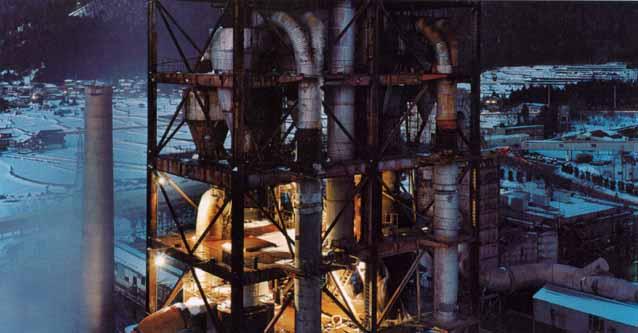
[Image: A lime works excavation tower seen against the landscape it will soon absorb. If the earth could make horror movies, one wonders if this would be the opening scene...]
I'm left with speculation:
If human beings actually do survive the next ten thousand years; if all this excavation not only continues but accelerates; if usable mineral deposits continue to be found, but only deeper and deeper beneath the earth's surface; then perhaps we might find that we've stripmined every continent below the waterline, returning the earth to the early Devonian, when warm, shallow seas covered most of the planet – only now, or then, the earth will be shelled by a new global city of interlocking excavation architectures – gantry cities, derrick towns, Constant's Babylon –
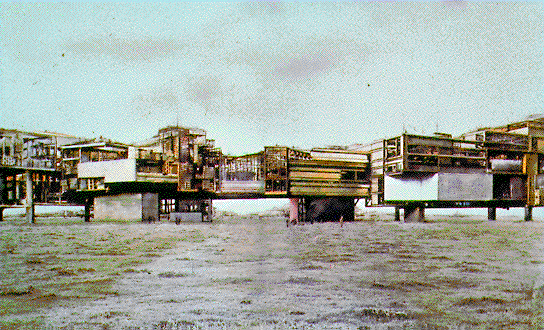
– complete with feudal rock-salt guilds and a new U.N. of floating lime works factories.
But deep below, in the dark webbing of undersea buttresses, where barrel vaults are covered with scabs of bleached coral, future geologists will be found scuba diving, like Steve Zissou, seeking out new metals and mineral deposits, torch in hand, scouring the outer edge of a flooded earth, diving further and further toward the core.
Then, one day, the digging machines simply put themselves out of business – because the planet has disappeared.
from bldgblog
標籤:
crazy human,
crazy times,
image,
Urbanism
The Monitor Mine
As old computer monitors – and harddrives, and printers, and scanners, and modems – continue to pile up in the cities and villages of the 3rd world, we're faced with a kind of mass geological displacement, or literal new mountain ranges of obsolete technology: all those minerals, the circuits and wires, forming new mines left open on the earth, leaching into groundwater, infiltrating bodies, forming cancers, going to waste.
A kind of monitor mine.
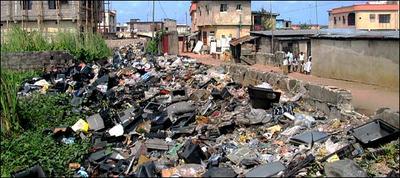 [Image: The Basel Action Network/New York Times].
In Perdido Street Station, by China Miéville, our erstwhile hero finds himself hiding out for some reason in a huge scrapyard full of refrigerators and harddrives and household waste and home appliances, and – yes – the whole thing just wakes up, anatomically rearranges itself – and mobilizes, artificially intelligent.
As if this could suggest that one day we might find deserts all over the world – their huge, moving dunes of loose silicon, in strange magnetic union with belts of metal in the earth's surface – have somehow programmed themselves, a planetary harddrive communicating through landfills overflowing with old computers, discarded wireless modems, mountains of digital rubbish piled in rings around African villages.
And it's not landscape tectonics but a new form of life...
(Perhaps a novel coming soon – from BLDGBLOG).
from BLDGBLOG
A kind of monitor mine.
 [Image: The Basel Action Network/New York Times].
In Perdido Street Station, by China Miéville, our erstwhile hero finds himself hiding out for some reason in a huge scrapyard full of refrigerators and harddrives and household waste and home appliances, and – yes – the whole thing just wakes up, anatomically rearranges itself – and mobilizes, artificially intelligent.
As if this could suggest that one day we might find deserts all over the world – their huge, moving dunes of loose silicon, in strange magnetic union with belts of metal in the earth's surface – have somehow programmed themselves, a planetary harddrive communicating through landfills overflowing with old computers, discarded wireless modems, mountains of digital rubbish piled in rings around African villages.
And it's not landscape tectonics but a new form of life...
(Perhaps a novel coming soon – from BLDGBLOG).
from BLDGBLOG
標籤:
crazy human,
crazy times,
image
订阅:
博文 (Atom)